Wed 2 Nov 2011, 16:15 GMT

'Progress' on LNG container ship concept


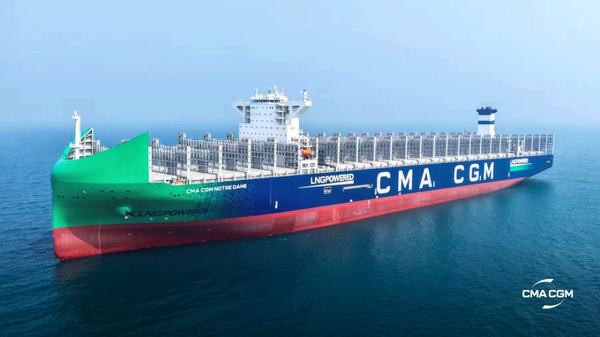
Daewoo Shipbuilding & Marine Engineering Co. Ltd (DSME) and Germanischer Lloyd (GL) claim that they have proved the feasibility of running large container vessels on LNG in a recently completed joint project.

At a press conference held during the Kormarine Trade Fair in Busan, both parties communicated the 'progress' they have made so far towards developing LNG-fuelled large container vessels. GL said it recently obtained approval, in principle, to develop a 14,000TEU LNG-fuelled container vessel for DSME.

"New technology is needed as cleaner transport is increasingly demanded and maritime environmental regulations are becoming ever stricter," said Frederick Ebers, Vice President and Area Manager for North East Asia, GL. "DSME and GL have acknowledged this challenge and agreed in 2010 to jointly start exploring technology options and safety concepts for large LNG-fuelled container vessels."

Following Mr.Seo from DSME, who demonstrated the design concept of this LNG-fuelled container vessel, Dr. Gerd-Michael Wuersig elaborated on the safety concepts involved. Dr. Wuersig is Deputy Head of Environmental Research Department of GL and also a member of IMO Correspondence Group for the development of the Code for Gas as Ship Fuel (IGF-Code).

He pointed out that most technical systems have been developed and examined and the major challenge lies in how to apply these technologies, especially when it comes to ensuring safe bunkering procedures.

"You have to guarantee there is no gas spill and protection measures against incidents and collisions are sufficient. Relevant solutions are under evaluation and will be available soon," he said.

Dr. Wuersig also mentioned that there are no restrictions on companies looking to build LNG-powered vessels on the basis of the interim guidelines because LNG-fueled vessels built according to the interim guidelines MSC. 285(86) will "certainly be allowed to operate", even if the IGF-Code is enforced, he said.

The IMO has agreed to reduce SOX emissions by controlling the sulphur content in marine fuels from 2015 onwards. For new vessels operating in ECAs (emission control areas), an 80 percent reduction of NOX emissions versus 2010 levels is required, starting from 2016. "This will make conventional fuel unattractive. But LNG can be an environmentally and economically sound option due to its high efficiency and lower impact on environment," said Dr. Wuersig.

Looking ahead, Dr. Wuersig predicted: "LNG-fueled cargo ships will be emerging on a large scale in the latter half of this decade. And there is a great potential for container ships to become one of the first cargo vessels using LNG as ship fuel."

GL has been a leading player in the adoption of relevant rules for LNG-fuelled ships. Under the assistance of GL, the IMO Committee on Maritime Safety developed and adopted "Interim Guidelines on Safety for Natural Gas-Fuelled Engine Installations in Ships". GL has also published guidelines for gas as a ship fuel.

GL is also currently involved in converting a 25,000 dwt product tanker Bit Viking [pictured] into the first GL-classed gas-fuelled ship.


Hapag-Lloyd and DSV logo side by side. Hapag-Lloyd and DSV sign 18,000-tonne CO2e reduction agreement for sustainable marine fuels  

Two-year framework allows inclusion of alternative fuels beyond biofuels in shipping decarbonisation partnership.

Bangkok city skyline. Uni-Fuels opens Thailand office as part of Southeast Asia expansion  

Marine fuel supplier establishes Bangkok entity, appoints managing director with 15 years’ industry experience.

Washington State Hybrid-Electric 160-Auto Ferry vessel render. Corvus Energy to supply battery systems for Washington State Ferries hybrid vessels  

ABB selects Corvus for two new 160-vehicle ferries as part of $3.98bn electrification plan.

Vinssen and Mana Engineering sign MoU. Vinssen, Mana Engineering partner on hydrogen fuel cell retrofit for 800-teu feeder vessel  

South Korean and Dutch firms to pursue Lloyd’s Register approval for hybrid retrofit concept.

Hercules Elisabeth vessel. Hercules Tanker Management takes delivery of second Ultra-Spec vessel in China  

Hercules Elisabeth is the second of 10 hybrid-ready tankers designed for alternative fuels.

Wolf 1 vessel. Petrol Ofisi launches fuel supply tanker Wolf 1  

Turkish bunker supplier adds 1,750-dwt vessel with alternative fuel infrastructure to fleet.

BIMCO meeting. BIMCO to convene for adoption of biofuel clause and ETS provisions at February meeting  

Documentary Committee to consider new contractual frameworks for alternative fuels and emission trading scheme compliance.

Sea Change II vessel render. Incat Crowther and Switch Maritime develop 150-passenger hydrogen ferry for New York  

Design work begins on 28-metre vessel with 720 kg hydrogen capacity and 25-knot speed.

Aerial view of a container vessel. HIF Global signs heads of agreement with German eFuel One for 100,000 tonnes of e-methanol annually  

Deal covers supply from HIF’s Uruguay project, with e-methanol meeting EU RED III standards.

Welcoming of Kota Odyssey at Jordan’s Aqaba Container Terminal. PIL’s LNG-powered vessel makes maiden call at Jordan’s Aqaba port  

Kota Odyssey is Pacific International Lines’ first LNG-fuelled ship to call at the Red Sea port.


 Recommended