Thu 23 May 2019, 12:17 GMT

Teekay Tankers upbeat on IMO 2020's 'positive impacts'


Refinery runs predicted to climb. Expected rise in scrubber-related off-hires seen as a positive.


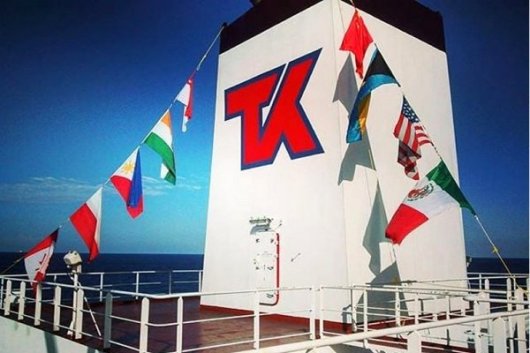
Image credit: Teekay Corporation
Teekay Tankers (Teekay) said on Thursday that it expects IMO's introduction of a 0.5% global limit on the sulphur content of marine fuels to be positive for the tanker market during the second half of 2019.

The Bermuda-headquartered firm noted that recent tanker demand had been negatively affected by higher-than-normal refinery maintenance, as refiners look to complete maintenance and upgrade programmes in anticipation of much greater demand in the second half of the year, when they will be required to operate at high throughput levels in order to produce sufficient distillates to meet the new IMO 2020 regulations.

Teekay also explained that, since January, global crude oil production had decreased by around 2.5m barrels per day (bpd) due to a contraction in OPEC supply, and that the global tanker fleet had risen by 12.6m deadweight tonnes (dwt), or 2.1 percent.

But in an upbeat analysis of the future, the tanker specialist said it expects refinery runs to climb between July and December as refiners prepare for IMO 2020 and the resultant jump in distillate demand that the new sulphur cap is set to generate.

Additionally, Teekay noted that global oil demand is predicted to grow by 1.3m bpd in 2019, according to EIA IEA and OPEC average forecasts; that global refinery throughput is forecast by the IEA to climb by 4.6m bpd between March and August; that US crude exports could rise to 4m bpd by the end of the year; and that the current tanker orderbook stands at 59.4m dwt, or 9.9 percent of the existing total fleet of 600.7m dwt - the lowest orderbook-to-fleet ratio in more than 20 years, and an indication that fleet growth could be relatively low over the next couple of years.

Added to this, Teekay posited that fleet availability could be weakened further by an expected rise in off-hires as ships are taken out of service to be fitted with scrubbers prior to IMO 2020.

In its financial results for the first quarter, Teekay Tankers posted a net income of $12.4m, which was a $31.6m improvement on last year's $19.2m loss.

Revenue during the three-month period grew year-on-year by $64.0m, or 38.0 percent, to $232.5m.

Discussing the results, Kevin Mackay, President and Chief Executive Officer, remarked: "Average crude tanker spot rates moderately increased during the first quarter of 2019, which resulted in another profitable quarter and slightly improved results over the prior quarter. However, spot tanker rates declined towards the latter half of the first quarter, and the market faces a number of seasonal and other short-term headwinds, which are expected to reduce our earnings during the second quarter of 2019. We believe these factors are temporary in nature and expect a significant firming in the tanker market from the second half of 2019 due to positive underlying oil demand, an expected increase in U.S. crude oil exports, higher OPEC production, lower tanker fleet growth, and the positive impacts of IMO 2020."

Mackay added: "With a stronger liquidity position, market-leading position in our vessel sectors and significant operating leverage, we believe we are well-positioned to benefit from a tanker market recovery in the second half of 2019 and into 2020."


Bermuda Container Line (BCL) logo. Bermuda Container Line imposes emergency bunker surcharge citing Iran War fuel price spike  

Shipping operator to add $150 per TEU charge from 1 May amid geopolitical fuel cost pressures.

China flag. Zhejiang’s first methanol-powered container ship launches in Jiaxing  

Vessel uses methanol propulsion technology to reduce carbon dioxide emissions by 90%.

TES flag with a model vessel in the background. TES joins SEA-LNG coalition to advance e-methane as marine fuel  

Green energy company targets 1m tonnes annual e-methane production by 2030 for shipping decarbonisation.

Ethanol and methanol workshop graphic. IBIA to host workshop on ethanol and methanol marine fuels during Singapore Maritime Week  

Half-day event will examine alcohol-based fuel pathways and integration into shipping’s multi-fuel landscape.

Steel-cutting ceremony for 13,000-dwt vessel. ROC begins construction of second chemical tanker for Essberger  

Chinese shipbuilder holds steel-cutting ceremony for 13,000-dwt methanol-ready vessel with ice class capability.

Norsepower and CHIC sign agreement. Norsepower and Cosco Shipping Heavy Industry Equipment sign wind propulsion cooperation agreement  

Wind propulsion technology provider partners with Chinese shipyard to scale rotor sail production.

Wärtsilä logo. Shipping firms struggle to prioritise decarbonisation investments amid regulatory uncertainty, Wärtsilä survey finds  

Survey of 225 maritime executives reveals 70% say uncertainty hinders investment decisions despite regulatory pressure.

IMT Isca G-Flex vessel render. Longitude Engineering unveils IMT Isca G-Flex PSV design with alternative fuel capability  

Naval architecture firm launches adaptable platform support vessel design based on the IMT-984 G-Class hull.

Philippos Ioulianou, EmissionLink. Shore power infrastructure is key to cutting ferry emissions in European cities, says EmissionLink  

Port electrification is needed to enable vessels to switch off engines at berth, reducing urban pollution.

Maritime and Port Authority of Singapore logo. Singapore prioritises maritime resilience amid geopolitical uncertainty, eyes digitalisation and green fuels  

MPA chief outlines the sector’s adaptation to supply chain disruptions while advancing automation and alternative fuels.