Mon 10 Dec 2018, 10:42 GMT

Silverstream hails air lubrication uptake ahead of 2020


Stresses importance of demonstrating fuel savings to maintain trust of shipping firms.


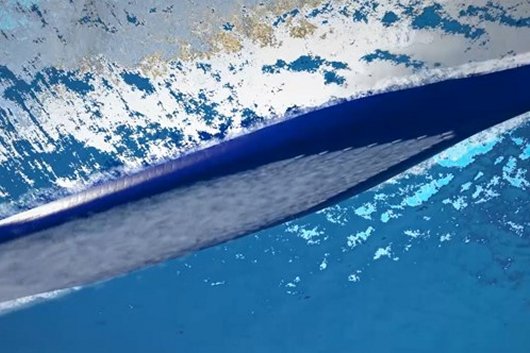
Animation still of the Silverstream System on the flat bottom of a vessel. The system is designed as a fully integrated solution and comprises purpose-built steel cavities and high-performance compressors controlled by an on-board control and monitoring system.
Image credit: Silverstream Technologies
Manufacturer Silverstream Technologies has hailed an increase in the uptake of air lubrication technology as owners seek viable fuel efficiency solutions in the run up to 2020.

Silverstream recently announced a major deal with Grimaldi Group to install the Silverstream System on 12 new ro-ro carriers. This followed the news that Carnival Corporation has also retrofitted the technology aboard the cruise vessel Diamond Princess.

However, Silverstream has also stressed that it is vital for manufacturers to continue to demonstrate rigour and transparency in R&D, and, ultimately, show proven efficiency savings to ensure that the trust of ship owners and operators in new clean technologies coming into the market is maintained.

Noah Silberschmidt, CEO, Silverstream Technologies, remarked: "It is heartening to see shipping's innovating spirit rise to the surface and for clean technologies, and in particular air lubrication, to be recognised as a commercially viable solution to both the industry's impending regulatory challenges and its growing demand for increased operational efficiencies and sustainability.

"A multifaceted and complicated regulatory environment is now unfolding for the sector; the impending 2020 fuel sulphur content cap and the acceptance of the need to decarbonise are both creating the context for clean technologies in an unprecedented fashion.

"As fuel prices rise as a result of regulation, owners will need a way to mitigate costs. Clean technologies are one of the best means to achieving this, but only if those solutions are credible, means-tested and proven.

"This proof is doubly important in a market of low liquidity, with owners and operators conceivably facing existential challenges about the future of their fleets. This means that they should only make an investment when faced with clear proof that a system works as it claims in terms of efficiency benefits."

Silverstream says it has worked for years to not only prove the efficiency savings of its air lubrication technology, the Silverstream System (which is said to achieve emission savings of up to 10 percent, depending on the type of vessel), but also to work with its wider regulatory network to accelerate the adoption of air lubrication systems and clean technologies in general within the shipping industry. This includes working with partners such as HSVA, Lloyd's Register and Shell to establish clear evidence of the technology's fuel savings potential.

Silberschmidt said: "What we can observe with this uptake is the clear signal that shipping has crossed an important threshold; air lubrication systems are now recognised by regulators and industry leaders as one of the most compelling ways to realise fuel and efficiency savings.

"The trust in the fundamental science of these technologies - which is now a proven way to reduce the hydrodynamic drag of a vessel and its carbon footprint - lays down the gauntlet for other clean technology manufacturers to follow in terms of seeking verification and proof of their systems.

"We welcome shipping's thriving clean technology market and stand firm in our belief that an innovating spirit is the best way for shipping to meet the challenges of 2020, decarbonisation and beyond."

As part of its advocacy work with IMO, Silverstream is part of the Global Industry Alliance, a public-private partnership initiative of the IMO under the framework of the GEF-UNDP-IMO GloMEEP, the aim of which is to support the uptake and implementation of energy efficiency measures for shipping, thereby reducing greenhouse gas emissions from the industry.


Meera naming ceremony. Naming ceremony held for LPG dual-fuel ammonia carrier  

VLAC Meera named during event held in China on 10 July.

IMO Council 137th session IMO adopts Singapore-led resolution on protection of shipping lanes  

Thirty co-sponsors back a resolution reaffirming navigational rights under international law.

TT-Line Green Ship 2.0 illustration. TT-Line orders second LNG-hybrid battery ferry for Baltic Sea operations  

German ferry operator doubles down on LNG-hybrid technology with a second next-generation newbuild.

CMA CGM Notre Dame and Gas Agility ship-to-ship (STS) bunkering operation. CMA CGM Notre Dame receives first European bio-LNG bunkering during Rotterdam maiden call  

LNG-powered container ship takes on bio-LNG derived from agricultural waste.

Carnival Destiny steel-cutting ceremony. Fincantieri marks 30 years with Carnival as steel cutting begins for new LNG-powered Carnival Destiny  

Italian shipbuilder Fincantieri has begun construction of the first of three new Ace-class ships for Carnival Cruise Line.

Svitzer Thames vessel. DP World and Svitzer bunker first HVO-fuelled harbour tug at London Gateway  

Carbon inset scheme expands as tug switches from marine diesel to HVO.

CM Shenzhen and Da Qing 268 ship-to-ship (STS) bunkering operation. Venture Energy and Sinopec HK complete 'Hong Kong’s largest ever green bunkering'  

Delivery of 1,000 tonnes of methanol to ro-ro vessel hailed as new record for Hong Kong.

Soo Yong Koo, Seascale Energy. Seascale Energy appoints Soo Yong Koo as business development director  

Industry veteran hired to drive customer growth in Asia and beyond.

Arctic Tern vessel. Wallenius Wilhelmsen takes delivery of first methanol-ready Shaper Class vessel  

The dual-fuel Arctic Tern will enter service on the Asia–Europe trade almost immediately.

Al Muraykh vessel. Hapag-Lloyd signs shore power agreement with Hamburg Port Authority  

Deal commits the carrier to using onshore power supply at all Hamburg terminals.