Thu 25 Oct 2018, 08:52 GMT

Rivertrace launches water-in-oil sensor


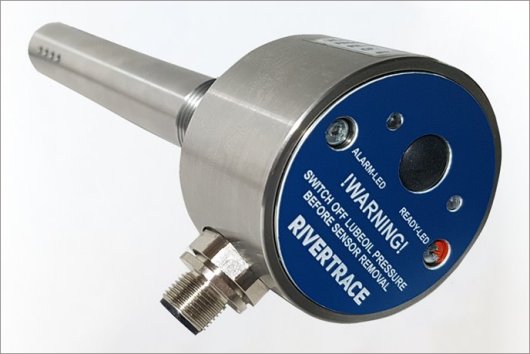
Smart WiO Sensor continuously monitors dissolved water content in oil to limit the risk of engine and machinery corrosion.


Rivertrace's Smart WiO Sensor is designed for preventative maintenance protocols and condition-based monitoring for lubricating and hydraulic oil, detecting water presence to avoid costly damage and premature wear with early warnings from pre-set alarms.
Image credit: Rivertrace
Rivertrace has expanded its product range with the addition of its new Smart WiO water-in-oil sensor that continuously monitors dissolved water content in oil, designed to allow ship operators to proactively limit the risk of engine and machinery corrosion.

UK-based Rivertrace notes that the contamination of oil with dissolved water poses a significant corrosion risk to engine machinery. All oil can absorb a certain volume of dissolved water up to a maximum concentration called the 'saturation point'. When the saturation point of an oil is exceeded, any unabsorbed water will fall out of the oil as free water and can cause corrosion inside the engine.

The saturation point can change with an oil's age, cleanliness, temperature and other factors including composition, whether the oil is mineral or synthetic and the formulation of additives.

Water-in-oil content has traditionally been measured by test kits which detect free water in lubricating oil or emulsion from 100.02 percent humidity. However, any water content values measured exceeding 100 percent humidity indicate that free water is already present, and the engine is being exposed to corrosion and oil degradation.

To mitigate corrosion risk from water in oil, Rivertrace has introduced the Smart WiO Sensor that uses capacitive measurement of absorbed water in oil with continuous monitoring. The Smart WiO Sensor continuously monitors water content value as 'percent humidity', taking consideration of the oil temperature. The sensor also measures the saturation of the oil independently from the oil type and oil age.

Its intended use is for preventative maintenance protocols and condition-based monitoring for lubricating and hydraulic oil, detecting water presence to avoid costly damage and premature wear with early warnings from pre-set alarms.

At 50 percent humidity, the WiO Sensor shows a pre-alarm, allowing the crew to take preventative actions to reduce the water content. At 90 percent humidity, the main alarm is triggered, alerting crew before any free water is present in the oil.

Gillian Peden, Business Development Manager, remarked: "As specialists in water quality monitoring we are expanding our range or products to offer our customers a partner for their maintenance and compliance monitoring needs. Rivertrace is committed to ensuring that the marine industry has the right tools to measure water in oil and limit the risk of engine corrosion and premature wear with our solution the new Smart WiO Sensor."


Methanol bunker fuel delivery. World Fuel Services and West Coast Clean Fuels launch methanol bunkering across US ports  

First over-the-water methanol delivery completed in South Florida with Coast Guard-approved procedures.

Valerie Ahrens. Burando Energies appoints Valerie Ahrens as global head of methanol  

Ahrens brings more than 30 years of energy sector experience to the marine fuels supplier.

New Sea Generation (NSG) logo. New Sea Generation seeks junior bunker trader in Greece  

Greek bunker firm advertises role requiring commitment to demanding work schedule and operational responsibilities.

Person signing a document. IINO Lines secures sustainable shipping finance for methanol dual-fuel VLCC  

Japanese shipowner signs impact financing agreement with Mizuho Bank for alternative-fuel tanker.

Fluxys logo. Fluxys Belgium reports EUR74.9m profit as LNG flows surge and hydrogen infrastructure begins  

Belgian gas infrastructure operator’s 2025 net profit fell 8.8% amid hydrogen and CO₂ investments.

VPS logo. Shale oil components detected in Singapore marine fuel | VPS  

VPS testing identifies 90,000 mt of delivered VLSFO containing Estonian shale oil compounds.

Constantinos Capetanakis, Star Bulk. IBIA chair completes two-year term, citing expansion in regulatory engagement and membership  

Outgoing chair to remain on Global Board and lead Future Fuels and Bunker Buyers’ working groups.

Aerial view of a container vessel. LNG and methanol investments risk becoming 'dead ends' for shipping decarbonisation, UCL study finds  

Research warns transitional marine fuels may lock in fossil infrastructure rather than enabling an ammonia pathway.

Vitalii Protasov, GENA Solutions Oy. Protasov: Renewable fuel supply could meet shipping demand, but offtake agreements remain a barrier  

GENA Solutions CEO highlights project pipeline growth but warns regulatory uncertainty hampers investment decisions.

Frontier Venture vessel. Wah Kwong takes delivery of first LNG-ready LR2 tanker with Bureau Veritas SMART notation  

Frontier Venture is first in newbuild series to achieve Group 3 'augmented ship' capabilities.