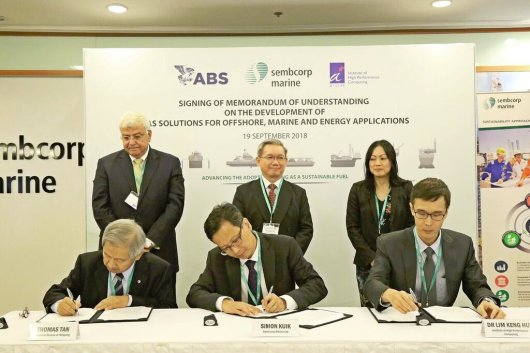
Sembcorp Marine, The American Bureau of Shipping (
ABS) and
A*STAR's Institute of High Performance Computing are teaming up to develop new gas technologies in offshore, marine and energy sectors in a move designed to help advance the adoption of LNG as a globally preferred fuel.
Through this alliance, the three organisations aim to make LNG more accessible, reliable and safer for industry and domestic consumption.
The research collaboration will see the partners leveraging one another's domain expertise, namely, Sembcorp Marine's offshore, marine and energy value chain solutions; ABS's LNG certification and experience in applying operational technology; and IHPC's expertise in high performance computing, system modelling and advanced simulation.
Memorandum of understanding (MOU)
A memorandum of understanding (MOU) has been signed covering the following areas:
Development of market-ready LNG solutions
Sembcorp Marine and ABS are to work on the approval and certification of Sembcorp Marine's gas value chain solutions for small-scale LNG applications, such as LNG-battery hybrid tugs, LNG bunker vessels and LNG terminals.
To enhance these solutions further, Sembcorp Marine is to tap the gas expertise and simulation capabilities of ABS and IHPC respectively.
LNG technology development
Sembcorp Marine, ABS and IHPC will focus on offshore LNG processing, transfer and containment, and new applications of LNG as a sustainable fuel. Through various joint developmental projects, they also seek to augment the safety and reliability of LNG for offshore applications.
Development of LNG-related capabilities
The technology partners will develop and conduct training and technical workshops through the Sembcorp Marine Academy to build and hone specialised knowledge and skill sets supporting the growth of LNG technology-related businesses.
Four key project areas
The projects will cover four main areas: LNG processing; LNG transfer; LNG containment; and the use of LNG as a sustainable fuel.
LNG processing
LNG processing typically involves liquefaction and regasification. When extracted from the field, natural gas is purified and liquefied through multiple compression and refrigeration cycles, and finally transported by large LNG tankers in a liquid state.
At the end-user - for example, a gas power plant - LNG is regasified as fuel for power generation. During the regasification process, a significant amount of cold waste energy is generated. The technology partners will explore efficient methods to recover, store and redistribute this energy for essential cooling or ventilation services.
LNG transfer
In small-scale LNG distribution using LNG bunker vessels and near-shore LNG terminals, frequent LNG loading and offloading cause an increased generation of boil-off gas.
Boil-off gas results from heat entering LNG tanks during storage and transportation, in turn causing the product to evaporate continuously into a gas that is commonly recovered as fuel for powering the tanker vessel carrying the LNG tanks.
The technology partners will carry out a holistic study on preventing or minimising boil-off gas generation during LNG transfer operations.
LNG containment
As LNG is stored in a liquid state at -162C, the design of LNG containment systems requires thorough structural safety considerations to prevent thermal shock damages to the containment systems' surrounding structures, piping and equipment.
The technology partners will employ multiple analyses - including heat transfer and finite element and fatigue analyses - to optimise the safe design of LNG containment systems.
Use of LNG as a sustainable fuel
To promote LNG fuel adoption, more comprehensive safety studies are expected to boost the confidence of end-users and regulators.
The technology partners aim to create a set of proven computational modelling and simulation approaches on gas dispersion and explosion scenarios in order to facilitate risk assessment and mitigation. These approaches will also be applicable to the design and operation of new-generation LNG-fuelled vessels and terminals.
At a later stage, the partners plan to carry out research on optimising the energy efficiency performance of Sembcorp Marine's LNG-powered ship designs, including LNG-battery hybrid tugs.
Speaking at the MOU signing, Sembcorp Marine President & CEO,
Wong Weng Sun, said: "While the benefits of LNG as an environmentally sustainable and affordable fuel are conclusive, we can do much more in the offshore, marine and energy sectors to advance its adoption as a preferred fuel for global consumption. I am therefore excited that Sembcorp Marine is working with ABS and IHPC to spearhead the development of new gas technologies, applications and solutions that could expedite this outcome. I am also very pleased that our Tuas Boulevard Yard will be a test-bed for the various projects identified. We certainly have a lot to look forward to in this collaboration and I wish the technology partners a resounding success."
Tony Nassif, ABS Executive Vice President and Chief Operating Officer, remarked: "As a global leader in gas, ABS is collaborating with innovative companies and organisations such as Sembcorp Marine and IHPC, to support the delivery of technologies that minimise the environmental impact of shipping."
Professor Tan Sze Wee, Executive Director of A*STAR's Science and Engineering Research Council (SERC), commented: "As Singapore's leading public sector R&D agency, A*STAR is committed to supporting large local enterprises like Sembcorp Marine to innovate and develop new technologies and capabilities. By driving R&D that encourages the adoption of LNG as a sustainable fuel, Sembcorp Marine will continue to have a competitive advantage in the global economy. With ABS, a renowned international body, on board, this collaboration is an exciting one with the potential to transform the offshore, marine and energy sectors, both locally and abroad."