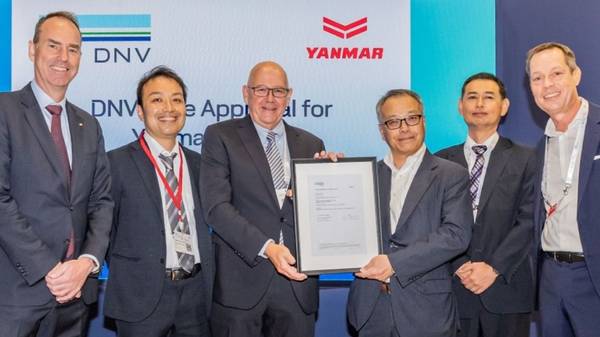
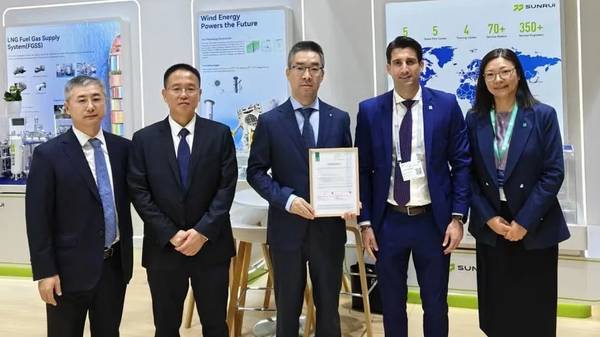
DNV GL has presented
Dalian Shipbuilding Industry Company Ltd (DSIC) with an approval in principle (AIP) certificate for a new LNG-fuelled very large crude carrier (VLCC) design at the first day of the Marintec China trade fair.
The new design has been found to comply with the 'Gas Fuelled' notation as given in the DNV GL rules for the classification of ships and the recently adopted International Code of Safety for Ships using Gases or other Low-flashpoint Fuels (IGF Code).
"This AIP is another step toward the more widespread adoption of LNG as a fuel for shipping," commented
Torgeir Sterri, DNV GL Vice President and Regional Manager in Greater China. "The emissions and efficiency benefits of LNG mean it is almost sure to become an important part of the fuel mix over the next few years. We have seen its adoption in many sectors already and now with this AIP, the world's first for a VLCC, this major shipping sector could see its first LNG-fuelled vessel soon."
Guan Yinghua, Deputy Technical Director of DSIC, remarked: "At DSIC we adhere to the principles of innovation, security, environmental protection and economic product concepts. DSIC will continuously concentrate on the innovation research of clean energy, ship efficiency and emission reduction, keeping ahead of green ships development in the future."
According to DNV GL, new LNG-fuelled VLCC design has several advantages over traditionally fuelled vessels. The design uses type C fuel tanks located on the open deck which minimizes the impact on the overall layout and results in cargo capacity being unchanged from the conventional design. Also, the LNG fuel tanks give the vessel the capability of performing a round trip from the Middle East to the US without refuelling.
The dual-fuel design gives greater flexibility in bunkering options and with duel fuel engines the vessel meets IMO NOx Tier III requirements in gas fuel mode. Using LNG also results in the complete elimination of particulates and sulphur oxide (SOx) emissions, and a significant reduction in carbon dioxide (CO2) emissions. In gas fuel mode, the design is said to achieve a 30 percent reduction factor to comply with Phase 3 of the Energy Efficiency Design Index (EEDI) regulations.
Deng Ling, DNV GL project manager and ship type expert for LNG as fuel, said: "In 2010, DNV GL developed the LNG-fuelled VLCC concept Triality. With DSIC's design and the approval in principle we have now seen the next step, a version which can now be put into the market. We are very proud to have been selected to work with DSIC on this project and look forward to seeing this eco-friendly design being welcomed by the industry."