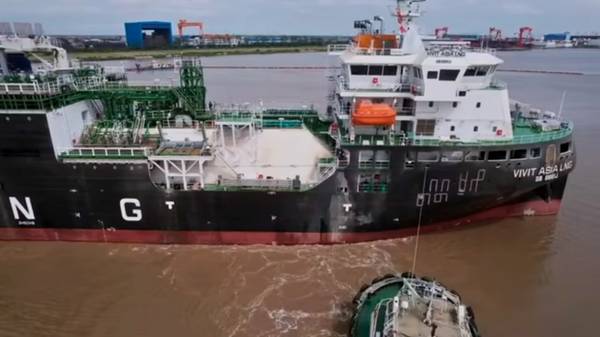
Following the installation of exhaust gas scrubbers on its self-unloading bulk carrier M/V Hon. James L. Oberstar,
The Interlake Steamship Company (Interlake) has confirmed that it plans to expand its emission-reduction efforts to one-third of its fleet by installing similar scrubber systems on the
M/V Lee A. Tregurtha [pictured] and
M/V James R. Barker early next year.
In April 2015, Interlake became the first U.S.-flag fleet to test freshwater scrubbers on the Great Lakes when the system became operational on the 806-foot Oberstar. The 826-foot Tregurtha and 1,003-foot Barker are to be equipped with the same single-inlet, closed-loop
DuPont Marine Scrubbers from
Belco Technologies Corp. (Belco), a division of DuPont Sustainable Solutions.
"This technology allows us to achieve our goal of continually shrinking our fleet's environmental footprint while dependably, safely and efficiently delivering raw materials to our steel, construction and power generation customers throughout the Great Lakes," commented Interlake President Mark Barker. "We have proven the technology on our 800-foot traditional Laker and now we're ready to scale up to our 1,000-foot class ships with our first installation on the James R. Barker."
A total of five Interlake vessels - including two additional 1,000-footers: the
M/V Paul R. Tregurtha and
M/V Mesabi Miner - are to be outfitted with these scrubbers by 2017.
"The Great Lakes is a shared community. Many of the men and women on our ships not only work on our ships, they live in the Great Lakes region. This important effort benefits the environment that we all live, work and play in, and has a positive impact on the health of the Great Lakes for the long term," Barker said.
The scrubber units, which are attached to the exhaust system of each of the ship's two engines, effectively strip the majority of sulphur from its stack emissions. Exhaust gas from the engine is sent through a series of absorption sprays that 'wash' and remove impurities, specifically sulphur and particulate matter. The washed gas then travels through a droplet separator before a clean plume of white steam is discharged into the atmosphere.
"The sulphur reductions have exceeded our expectations," Barker said, adding that the additional reductions make an even stronger case for marine transportation as an environmentally friendly way to deliver raw materials.
"DuPont/Belco has been an incredible partner in working with us on this effort of implementing freshwater closed-loop scrubbers on a retrofit basis. We are pleased with the performance of not only the scrubber units but DuPont/Belco's level of service, expertise and dedication to these important projects. We look forward to working with them further as we continue to supply our fleet with these scrubber systems," added Barker.
At the end of the 2015 navigation season, the Tregurtha and Barker are scheduled to sail to Bay Shipbuilding in Sturgeon Bay, Wisconsin, to have the scrubbers and associated equipment installed during the winter layup, in early 2016. Bay Shipbuilding is where the installation on the Oberstar was completed earlier this year.
In addition to being the first U.S.-flagged fleet to use freshwater scrubbers on the Great Lakes, Interlake has also developed a sustainable supply-and-delivery infrastructure to support their widespread use in the area.
Specifically, the scrubber system relies on an injection of sodium hydroxide - to neutralize and remove sulphur from the exhaust gas - and that chemical has to be delivered to the vessel around twice a month.
Working with partners, Hawkins Inc., PVS Chemicals Inc., Garrow Oil & Propane and OSI Environmental, the company has established waterfront supply capability at Sturgeon Bay, Wisconsin, and Detroit, Minnesota, and expects to develop a similar capability in Duluth, Minnesota, hopefully within the next month. From there, the supply-and-delivery infrastructure will be built out at ports located near East Chicago, Illinois, and Burns Harbor, Indiana.
The scrubber expansion announcement comes only weeks after the company announced its plans to re-power its last steamship - the
S.S. Herbert C. Jackson - in the final phase of a 10-year, $100 million modernization effort.
Image: M/V Lee A. Tregurtha