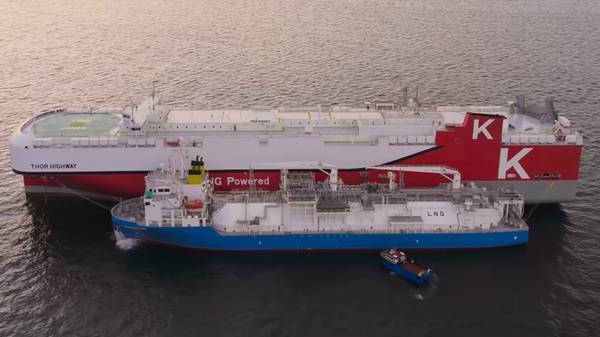
Source: Lloyd’s Register
New research from
Lloyd’s Register and
University College London’s Energy Institute explores the drivers for the future energy mix in shipping in 2030.
– Report indicates that in all scenarios heavy fuel oil remains the main fuel for deep sea shipping; LNG develops a deep sea bunker market share of 11%; low sulphur heavy fuel oil and hydrogen emerge as alternatives in certain scenarios.
– In Global Commons, the most optimistic scenario for a more sustainable world, global greenhouse gas emissions from shipping decline from 2025 despite significant growth in shipping.
– Study shows that the combination of growth in trade and reduced emissions would require a reduction in fossil fuel dependency and the commencement of a transition to a zero carbon fuel like hydrogen.
Global Marine Fuel Trends 2030 (GMFT 2030) released by Lloyd’s Register provides insight into future fuel demand for the containership, bulk carrier/general cargo and tanker sectors – representing approximately 70% of the global shipping industry’s fuel demands.
Shipping is the enabler of world trade – if world trade grows then so will seaborne tonne miles of cargo. The GMFT 2030 report issued last year indicates we can expect strong growth for shipping. With emissions regulations and rising energy costs, shipping decision makers will benefit from a clearer understanding of the potential scenarios for marine fuel demand.
The three scenarios are:
Status Quo – The world will continue its current growth momentum with some booms and busts over the next twenty years.
Global Commons – A shift to concern over resource limitation and environmental degradation will see a desire for a more sustainable world being developed and fairness in wealth distribution. Governments will find common ground and accelerated economic growth, within a framework of sustainable development, which will follow.
Competing Nations – States act in their own national interest. There will be little effort to forge agreement amongst governments for sustainable development and international norms. This is a self-interest and zero-sum world with a likely rise in protectionism and slower economic growth.
So what does the marine fuel mix look like for containers, bulk carriers and tankers by 2030? In two words: decreasingly conventional. Heavy fuel oil (HFO) will still be very much around in 2030, but in different proportions for each scenario: 47% in Status Quo, to a higher 66% in Competing Nations and a 58% share in Global Commons, the most optimistic of scenarios for society. A high share of HFO, of course, means a high uptake of emissions abatement technology when global emissions regulations enter into force.
The declining share of HFO will be offset by low sulphur alternatives (MDO/MGO or LSHFO) and by LNG, and this will happen differently for each ship type and scenario. LNG will reach a maximum 11% share by 2030 in Status Quo. Interestingly, there is also the entry of Hydrogen as an emerging shipping fuel in the 2030 Global Commons scenario which favours the uptake of low carbon technologies stimulated by a significant carbon price.
"I think that the report underlines that any transition from a dependency on HFO will be an evolutionary process," comments Project Leader,
Dimitris Argyros – LR’s Lead Environmental Consultant. "LNG is forecast to grow from a very low base to a significant market share by 2030 – even if there is no major retro-fit revolution – most of the LNG take-up will be in new buildings. But it is important to note that an 11% share in 2030 is the equivalent in volume of about 20% of the bunker market today."
"What we can say is that the uptake of engine and alternative propulsion technology and the emergence of non-fossil fuels can only be driven by a society’s ability to create a world with lower GHG emissions – the technology is not the barrier. Key will be policy and markets. Shipping can control its own destiny to some extent – but shipowners can only focus on compliance and profitability. If society wants lower GHG emissions and cleaner fuel, change in shipping has to be driven by practical regulation and market forces so that cleaner, more efficient ships, are more profitable than less efficient ships with higher GHG emissions."
GMFT 2030 boundaries are wide but not completely inclusive: we examine the containership, bulk carrier/general cargo and tanker (crude and chemical/products) sectors, representing approximately 70% of the shipping industry’s fuel demand in 2007. We include fuels ranging from liquid fuels used today (HFO, MDO/MGO) to their bio-alternatives (bio-diesel, straight vegetable oil) and from LNG and biogas to methanol and hydrogen (derived both from methane or wood biomass).
Engine technology includes 2 or 4 stroke diesels, diesel-electric, gas engines and fuel cell technology. A wide range of energy efficiency technologies and abatement solutions (including sulphur scrubbers and Selective Catalytic Reduction for NOx emissions abatement) compatible with the examined ship types are included in the modelling. The uptake of these technologies influences the uptake of different fuels.
Regulation is aligned with each of the 3 overarching scenarios to reflect business-as-usual, globalisation or localisation trends. They include current and future emission control areas (ECAs), energy efficiency requirements (EEDI) and carbon policies (carbon tax). Oil, gas and hydrogen fuel prices are also linked to the Status Quo.
Image: LNG Sokoto, operated by Bonny Gas Transport Ltd.