This is a legacy page. Please click here to view the latest version.
Tue 22 Feb 2011, 13:57 GMT

Ship achieves trim-related fuel savings


Vessel cuts fuel consumption by 3.1 percent over a 500-day period.


Eniram, provider of advanced decision support systems for the shipping industry, has today announced the results from a 136 day study that focuses on the areas of energy loss relating to propulsion and examines where there is an opportunity for performance improvements.

The data for this study was collected via Eniram’s Dynamic Trimming Assistant (DTA), which uses attitude sensors fixed onboard the container vessel, as well as information from the existing bridge and automation systems. With DTA the key metrics are presented to vessel officers at the bridge as an easy-to-read traffic light monitor (not enabled during this study), to dynamically monitor and optimise the trim.

According to Eniram, the results of the study show that sailing at non-optimal trim is the highest factor in the unwanted use of fuel that can actually be managed. The average percentage of propulsion power loss due to non-optimal trimming was 5 percent, whilst the vessel was on long, transoceanic legs.

During the study, the vessel operated at a number of different displacements. When the vessel was operated at a heavy displacement, close to the design displacement, the savings potential compared to operating at optimum trim was 2.2 percent. When operating the vessel at a medium displacement, the trim related savings potential grew dramatically to 6.8 percent.

During the 136 day study, the trim-related savings potential was calculated at 350 tonnes of heavy fuel oil (HFO). Eniram points out that even if operational constraints meant that the ship was only able to follow an optimum trim 80 percent of the time, 280 tonnes of fuel would still have been saved, which would have resulted in a US$160,000 reduction in bunker costs for the vessel operator in less than 5 months.

As well as aiming to offer an improved awareness and understanding of vessel operations, the study also aimed to provide proof of major environmental benefits through the significant reduction in greenhouse gas emissions. According to Eniram's calculations, by sailing the vessel at optimal trim during the 136 day voyage period the operator would have prevented around 880 tonnes of CO2 entering the atmosphere.

After the end of the study period, the Eniram DTA system was fully enabled on the vessel, providing the crew with a simple, real-time guide to both the vessel’s dynamic and optimal trims. The system now has been in use on the vessel for over 500 days and the actual savings achieved have been confirmed as 3.1 percent.

"The results of this extensive study, and subsequent real-life utilisation, are quantifiable proof of the benefits of maintaining optimal trim and how it can not only provide the operator with key fuel and cost savings, but also significantly reductions in emissions," Eniram said.

The company says that it has also undertaken similar studies on a Cruise Ships, RoPax vessels and a VLCC tanker.

In addition to the savings, the performance related data collected from onboard the vessel is also able to give a broader view of the vessel’s performance, thanks to Eniram’s innovative FLEET solution. FLEET is an intelligent, web-based reporting tool that enables operators and owners to establish KPIs for monitoring vessel performance across their fleet. The tool generates reports for KPI tracking and comparison that will allow operators to measure, monitor and, if desired, incentivise overall vessel efficiency targets.


Vessel at sea with Graphyte and NYK Line logos. NYK to offset ship emissions with CDR credits from Loblolly project  

Japanese shipping group turns to biomass-based carbon sequestration to address residual maritime emissions.

Close-up view of a KESS vessel. K Line orders four LNG dual-fuel car carriers for European short-sea operations  

Kawasaki Kisen Kaisha contracts quartet of 1,380-vehicle vessels at China Merchants Jinling Shipyard.

Bunge logo. Bunge seeks bunker purchaser for Rotterdam operation  

Agribusiness is looking for candidates with experience in marine fuel procurement.

Launching ceremony of a 38,000-dwt chemical tanker with hull no. XY169. First vessel in NYK Stolt Tankers’ newbuild series launched in China  

FKAB-designed 38,000 DWT chemical tanker launched at Nantong Xiangyu Shipyard, China.

Damen Combi Freighter (CF) series vessel render. Damen expands biofuel-compatible Combi Freighter series with CF 6000 and CF 7000 designs  

Damen Shipyards Group adds two larger variants to its Combi Freighter series, offering up to 40% more cargo capacity.

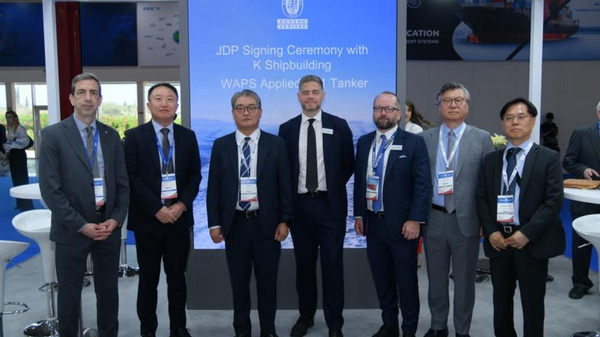
JDP signing ceremony for WAPS-equipped LR1 tanker. K Shipbuilding, bound4blue and Bureau Veritas launch joint project for wind-assisted LR1 tanker  

The three partners are collaborating on a 74,000-dwt LR1 tanker design incorporating wind-assisted propulsion.

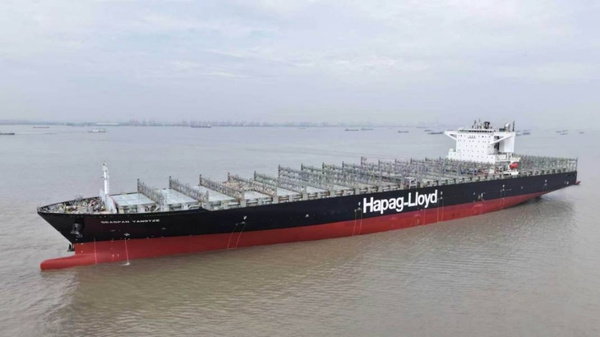
Seaspan Yangtze vessel. Hapag-Lloyd and Seaspan complete first methanol retrofit under five-ship programme  

The Seaspan Yangtze has been converted to dual-fuel methanol operation as part of a $120m programme.

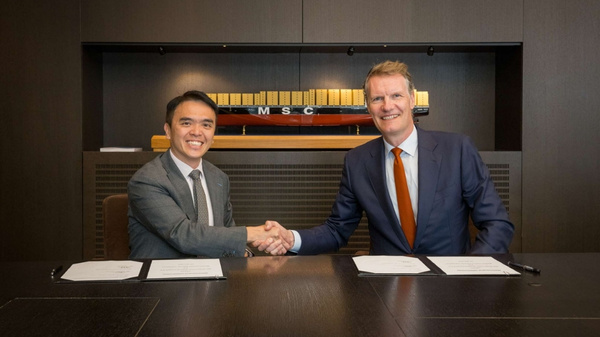
MPA and MSC sign MoU. MPA and MSC sign MoU covering decarbonisation, digitalisation and talent development in Singapore  

The agreement marks 30 years of MSC’s presence in Singapore and covers alternative fuels adoption.

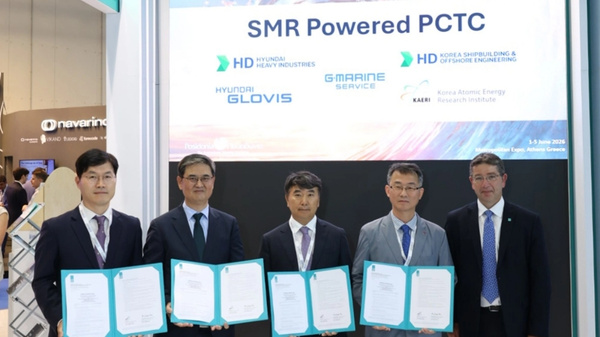
AiP award ceremony for SMR Powered PCTC. Lloyd’s Register backs nuclear car carrier concept with Korean partners at Posidonia 2026  

LR and Korean partners receive approval in principle for SMR-powered pure car and truck carrier concept.

AiP award ceremony for an 88,000 cubic metre dual-fuel VLGC. Lloyd’s Register expands Korean shipyard partnerships at Posidonia 2026  

A series of agreements covering alternative fuels and emerging technologies was announced at the Athens exhibition.


↑  Back to Top