This is a legacy page. Please click here to view the latest version.
Thu 19 Jul 2018, 10:11 GMT

GP Global inks accord to produce and market Cepsa marine lubes in India


GP Global to manufacture, blend, package, import and market Cepsa-branded marine lubricants.


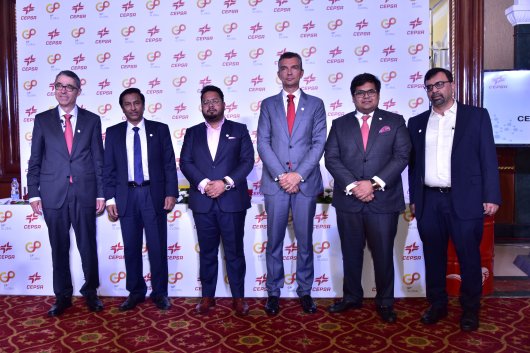
Representatives of GP Global and Cepsa at the signing of the agreement in Mumbai, India.
Image credit: Cepsa
GP Global has entered into an exclusive partnership with Cepsa that will see GP Global manufacture, blend, package, import and market Cepsa-branded marine lubricants in India.

The production of marine lubricants is to be carried out by GP Global's subsidiary, GP Petroleums, at the firm's plant at Vasai, Mumbai, which is already engaged in blending automotive and industrial lubricants, and is certified with ISO 9001, ISO 14000 and OHSAS 18001.

The product range is to include two-stroke and four-stroke engine oils, hydraulic oils, gear oils, greases and other specialty marine lubricants.

Cepsa's marine range of products comprises Cepsa Larus, Gavia, Ciconia and Petrel lubricants, among others.

Commenting on the agreement, Alvaro Diaz Bild, Vice President - Marketing, Cepsa, remarked: "This partnership will strengthen Cepsa's international brand and the expansion of our lubricant business. This will be the first time our lubricants will be produced outside our plants in Spain, as the facility in Mumbai has been the first approved by us after a rigorous and successful audit process. GP Global complies with our highest standards requirements, occupies a strong position in the Indian maritime industry, and has in-depth know-how of the lubricant and bunkering businesses."

"The partnership with GP Global will provide the necessary framework to enter into the Indian market as [GP Global] has great experience in the marine market, especially in bunkering," noted Carlos Giner, Director of Lubricants, Base Oils and Paraffin Waxes at Cepsa.

Cepsa is currently one of the leading manufacturers and marketers of finished lubricants and base oils in Spain, and exports products to Europe and other expanding markets, such as Latin America, Middle East and North Africa and Asia. It has two specialized lubricants plants in Spain: in San Roque (Cadiz) and Paterna (Valencia).

GP Global (recently rebranded from Gulf Petrochem) is a supplier and trader of marine fuel, physically supplying in India, Netherlands, Singapore and the UAE. Most recently, the company opened a new office in Hull, UK, and also in Seoul, South Korea.


A Maersk vessel, pictured from above. Maersk and Hapag-Lloyd suspend Strait of Hormuz transits amid Middle East security crisis  

Container carriers reroute services around the Cape of Good Hope as military conflict escalates.

Map of Middle East. Operations continue as normal at most Middle East ports  

Most facilities operating normally, with exceptions in Oman and Saudi Arabia.

Photograph of the 93,000-cbm very large ammonia carrier (VLAC) Gaz Ronin. Naftomar takes delivery of 93,000-cbm dual-fuel ammonia carrier  

Gaz Ronin features a MAN dual-fuel engine with high-pressure selective catalytic reduction technology.

Aurora Botnia leaving harbor. AYK Energy completes world’s largest marine battery retrofit on Wasaline ferry  

Aurora Botnia receives 10.4 MWh battery system, bringing total capacity to 12.6 MWh.

Steel cutting ceremony for an LNG dual-fuel 307,000-tonne crude oil tanker with builder's hull no. 113. Dalian Shipbuilding begins construction on LNG dual-fuel crude tanker  

Development is one of a number of milestones reported by parent company over the past few days.

Photograph of Sallaum Lines' Ocean Breeze vessel with 'Introducing The Blue Corridor' overlaid text. Sallaum Lines launches Blue Corridor sustainability initiative for Europe–Africa ro-ro trade  

Company deploys LNG-capable vessels with AI routing and eco-speed protocols on new green shipping corridor.

The platform supply vessel Viking Energy. Eidesvik Offshore signs yard contract for ammonia retrofit of PSV Viking Energy  

Halsnøy Dokk to convert platform supply vessel as part of EU-backed Apollo project.

Vanquish tanker alongside Jette Theresa oil/chemical tanker docked at terminal. North Sea Port completes risk analysis for alternative fuel bunkering operations  

Port authority says LNG, hydrogen, methanol and ammonia can be safely refuelled across its facilities.

Container ship near a port. Ammonia emerges as most feasible alternative fuel for deep-sea shipping in 2050 emissions study  

Research combining expert survey and technical analysis ranks ammonia ahead of hydrogen and methanol.

Cargo vessel at sea. EMSA study examines biodiesel blend spill response as shipping adopts alternative fuels  

Research addresses knowledge gaps on biodiesel-conventional fuel blends as marine pollutants and response measures.


↑  Back to Top