This is a legacy page. Please click here to view the latest version.
Thu 18 Jan 2018, 17:17 GMT

Fenosa and Balearia ink Spain's first multi-year LNG bunker supply deal


10-year accord will see Fenosa act as exclusive LNG supplier at all Iberian Peninsula ports.


Gas Natural Fenosa and Balearia have signed Spain's - and the Iberian Peninsula's - first multi-year, fixed-term LNG bunker supply agreement.

The exclusive supply deal is for 10 years and will initially be for deliveries in Barcelona, Valencia and Algeciras, but will extend to all the Iberian Peninsula ports at which the ferry firm operates, as well as the company's new fleet of LNG-powered ships.

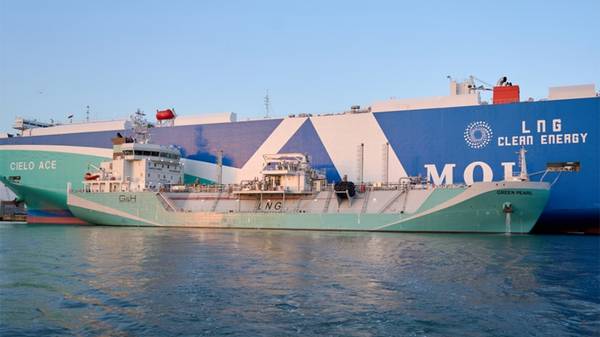
As part of the agreement, Fenosa will have a dedicated LNG supply vessel in Barcelona; the two firms are also working on a land-based supply solution for Valencia and Algeciras, Fenosa said.

Joaquin Mendiluce, Fenosa's Director of Wholesale Marketing for the Iberian Peninsula, commented: "At Gas Natural Fenosa we work to offer solutions that allow for the sustainable and profitable development of maritime transport. The agreement we have reached with Balearia corroborates this, as we have designed a different technical solution for each of the ports in which we are going to carry out the gas supply."

Adolfo Utor, president of Balearia, remarked: "In our commitment to LNG, the agreement with Gas Natural Fenosa represents a strategic alliance. We are currently building the first two vessels propelled by this clean energy that will operate in the Mediterranean. It is expected that at the beginning of next year, the first will begin to operate, which makes us pioneers in the use of LNG. We bet on clean energy because we are convinced that we can fight against climate change and at the same time be competitive."

As Bunker Index previously reported, last year Fenosa performed the first Barcelona LNG delivery to a Balearia ferry on January 29.

Last week, Fenosa launched what it described as the world's first universal floating LNG transfer system.


CMA CGM Eugenie naming ceremony. CMA CGM names 15,000-teu methanol-fuelled containership CMA CGM Eugenie  

Vessel to operate on Phoenician Express service linking Asia, Middle East, and Mediterranean.

Christian Larsen, Island Oil. Island Oil appoints Christian Larsen as senior trader in Denmark expansion  

Marine fuel supplier establishes operations in Denmark as part of expansion strategy.

HIF Global and Government of Uruguay MoU signing. HIF Global signs Uruguay agreement to advance US$5.3bn e-fuels facility in Paysandú  

Memorandum sets roadmap for final investment decision on plant targeting 880,000 tonnes annual production.

CMAL vessel. Corvus Energy wins largest-ever contract for seven electric Scottish ferries  

Battery systems supplier secures record order from Remontowa Shipbuilding for CMAL's Small Vessel Replacement Program.

HiMSEN H32CDF-LA engine classification approval test. HHI-EMD secures type approval for 5.4MW ammonia engine  

Lloyd's Register approves H32CDF-LA dual-fuel engine following three-day testing programme in Korea.

Atticus vessel. Global Fuel Supply acquires first bunker tanker  

Company transitions from chartering vessels to ship ownership with asset to be renamed MV Blue Alliance.

ABB Generations 2025 publication on smartphone. ABB publishes 2025 maritime insights on decarbonisation and digitalization  

Technology firm compiles annual articles exploring energy efficiency, automation, and alternative fuels for the shipping industry.

ClassNK AiP handover ceremony for bulk carrier design. ClassNK grants approval for multi-fuel ready bulk carrier design by Oshima Shipbuilding  

Vessel design accommodates future conversion to ammonia, methanol, or LNG with carbon capture capability.

The Arctic and black carbon graphic. Four countries propose Arctic fuel measure to cut black carbon from shipping  

Proposal to IMO's PPR 13 meeting aims to establish fuel regulations under MARPOL Annex VI.

T&E chart 1. Spain, Norway and Denmark lead Europe's green shipping fuel production, study finds  

Regulatory uncertainty prevents most e-fuel projects from progressing beyond the planning stage, says analysis.


↑  Back to Top