Reinforcing its role as a major supplier of electric propulsion technology for liquefied natural gas (LNG) ships,
General Electic's (GE) Power Conversion business recently received a series of new orders from
South Korean companies
Daewoo Shipbuilding & Marine Engineering and
Hyundai Heavy Industries. The GE equipment will be installed on 23 new LNG ships and represents total propulsion power of 1,105 megawatts.
"These orders clearly demonstrate that GE's expertise in electric propulsion for LNG applications is recognized worldwide by the major players in the sector," said
Paul English, marine vertical leader for GE's Power Conversion business. "Our continuous investment in innovation and competitive solutions allows us to customize and optimize our offerings to meet ship owners’ specific requests."
The scope of GE’s contracts includes MV7000 converters, induction motors, transformers, generators, main and cargo switchboards and propulsion control systems. Manufacturing for all propulsion motors is based in GE’s rotating machines plant in
Nancy,
France, while the propulsion systems are engineered at the GE merchant marine center of excellence in Belfort, France.
GE’s motors and converter are designed and optimized to make the propulsion systems easy to maintain. The induction machines are driven by press-pack IGBT Pulse Wide Modulation (PWM) converters to offer high levels of reliability in a compact design. GE’s global electric propulsion systems provide customers with high efficiency, availability and layout flexibility.
GE’s Growing Role in the LNG Ship Propulsion Sector
Traditionally, the propulsion of LNG tankers has been based on boil-off boilers and steam turbines. In recent years, more and more ship owners have turned to dual-fuel engine systems combined with electric propulsion as more efficient solutions, up to 30 percent at high loads. Moreover, these solutions increase cargo capacity by 3 to 5 percent as they enable the ship designer to optimize the equipment layout.
GE’s Power Conversion unit was the first company to equip a full-size LNG carrier with electric propulsion. The order was placed in 2002 for the vessel
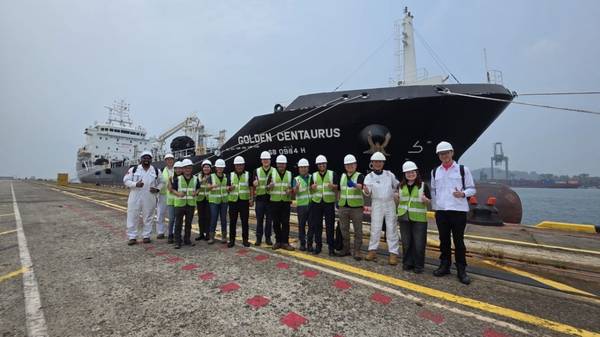
Gaz de France Energy [pictured]. This project was followed by a series of orders in 2005 and 2006 for eight large LNG carriers built in Korea. During the next two years, GE was selected to equip the latest generation of LNG carriers with new advanced electri propulsion systems.
GE Energy acquired
Power Conversion (then known as
Converteam) in September 2011. GE Energy’s Power Conversion business applies the science and systems of power conversion to help drive the electric transformation of the world’s energy infrastructure. It serves specialized sectors such as energy, marine, industry and all related services.
Image: Gaz de France Energy ship