Fri 7 Oct 2011, 11:18 GMT

Wärtsilä to equip first US-flagged LNG offshore vessel


Finnish firm to supply LNG propulsion equipment for two offshore supply vessels.


Wärtsilä has revealed that it will deliver an integrated propulsion system based on the use of LNG for two offshore support vessels for operation in the Gulf of Mexico. This is the first time U.S. flagged offshore supply vessels will run on LNG.

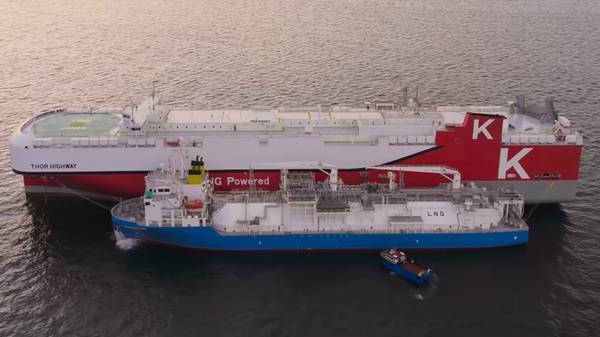
Wärtsilä has been awarded a contract in October 2011 to supply liquefied natural gas (LNG) propulsion equipment for two advanced offshore supply vessels owned by Harvey Gulf International Marine. These supply vessels will be the first ever U.S. flagged platform supply vessels (PSV) to be powered by LNG. The contract includes options for supplying propulsion equipment for additional follow-on vessels.

Wärtsilä will deliver an integrated system that includes the dual-fuel machinery, electrical and automation package, complete propulsion, and also the LNG fuel storage and handling components. The STX Marine Inc SV310DF Offshore Support Vessels will be powered by Wärtsilä 6-cylinder 34DF dual-fuel engines.

The LNG storage capacity of 290 cubic meters (m3), enables more than a week of vessel operational time. In addition, the vessels will carry 5520 tons of deadweight at load line and have a transit speed of 13 knots. The vessels are scheduled for delivery in two years and will operate in the Gulf of Mexico.

Shane Guidry, Harvey Gulf International Marine's Chairman and CEO, said that the stringent governmental demands for reduce emissions, together with predictions that availability of ultra low sulphur diesel fuel will be restricted, caused the company to consider the use of gas as fuel. "We're committed to bringing the world's best technologies to our customers, and these vessels with Wärtsilä's integrated system based on the use of LNG further demonstrates Harvey Gulf's Going Green Vision," he commented.

Pete Jacobs, Business Development Manager, Offshore at Wärtsilä North America added: "It's a pleasure to work with a company such as Harvey Gulf whose management is dedicated to introducing advanced, clean, natural gas supply vessels. These modern supply vessels showcase Wärtsilä's leading position as a complete solutions provider of LNG propulsion with electric drive systems."

"We are witnessing a transformation of the marine industry as it charts a course towards a new era for natural gas. It's exciting for Wärtsilä to be a trusted partner in this launch with industry leader Harvey Gulf, whose natural gas supply vessel investment actions of today signal a coming paradigm shift. This is aimed at capturing operational savings while simultaneously reducing emissions," said John Hatley, Vice President Ship Power, Wärtsilä North America.

Dual-fuel technology meets economic and environmental targets

Wärtsilä has been at the forefront in the development of highly efficient dual-fuel engine technology, allowing the same Wärtsilä 34DF engine to be operated on either gas or diesel fuel with full EPA emissions Tier 2 compliance. This dual-fuel capability means that when running in gas mode, the environmental impact is minimized since nitrogen oxides (NOx) are reduced by some 85 per cent compared to diesel operation, sulphur oxide (SOx) emissions are completely eliminated as gas contains no sulphur, and emissions of CO2 are also lowered. Natural gas has no residuals, and thus the production of particulates is practically non-existent.

"The shipping industry finds the operational savings that gas offers to be very compelling. Similarly, the significant environmental benefits that LNG fuel provides are of increasing importance. With fossil fuel prices, and especially the cost of low sulphur marine fuel, likely to continue to escalate, gas is an obvious economic alternative," Wärtsilä said.

Drawing from decades of experience in the development and application of natural gas engines for both the power generation and marine industries, Wärtsilä is the global leader in this advanced technology. Wärtsilä recently passed the 3 million running hours milestone with its dual-fuel engine technology.


Suezmax crude oil tanker render. Guangzhou Shipyard secures Suezmax order, delivers vessels ahead of schedule  

China State Shipbuilding subsidiary reports nine vessel deliveries in the first quarter of 2026.

Clean ammonia project pipeline chart as of March 2026. Renewable ammonia pipeline grows despite Norway project freeze  

GENA Solutions tracks 325 projects totalling 146 MMT of capacity by 2034 despite execution challenges.

Antwerpen and Arlon naming ceremony. Exmar names world’s first ocean-going ammonia dual-fuel gas carriers in South Korea  

Two 46,000-cbm vessels can reduce CO₂ emissions by up to 90% during navigation.

Fujian province map with highlighted locations. Gulf Marine expands bonded lubricant supply network in China’s Fujian province  

Company adds supply points in Putian, Ningde and Fuqing, covering 20 terminals across the region.

Excelerate Acadia naming ceremony. Bureau Veritas classifies Excelerate Energy’s new 170,000-cbm FSRU Excelerate Acadia  

Vessel built by HD Hyundai Heavy Industries features dual-fuel engines and proprietary regasification system.

Osprey Energy logo. Osprey Energy seeks junior bunker trader to support Cebu trading activities from Netherlands  

Dutch marine fuel supplier targets Cebu region expansion through new training programme for Filipino candidates.

EUA prices dropping graphic. KPI OceanConnect highlights falling EUA prices as opportunity for shipowners to lock in compliance costs  

Marine fuel firm says timing carbon allowance purchases can reduce costs as EU emissions scope expands.

RINA employee in control room. RINA partners with Hanwha Group on battery-hybrid propulsion for ro-ro ferries  

Classification society to provide regulatory compliance verification for hybrid battery systems on newbuilds and retrofits.

Amadeus Titanium vessel. HGK Shipping’s Amadeus Titanium fitted with wind assistance system  

Coastal vessel equipped with VentoFoils at Dutch port to reduce fuel consumption on Covestro routes.

Sebastian Weder, Bunker One. Bunker One expands physical supply operations to Tallinn and Finland  

Marine fuel supplier extends Baltic Sea coverage with new operational presence in Estonia and Finland.