Wärtsilä and
Shell Oil Company have signed a Joint Co-operation Agreement aimed at promoting and accelerating the use of liquefied natural gas (LNG) as a marine fuel. The agreement was signed in August 2011 and will run for several years.
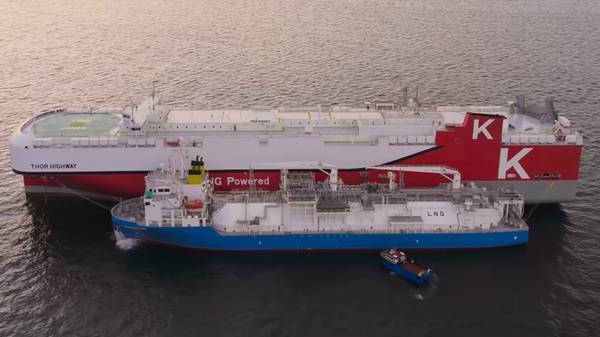
Supplies of low cost, low emissions LNG fuel will be made available to Wärtsilä natural gas powered vessel operators, and other customers by Shell. The Joint Cooperation Agreement will focus first on supplies from the
US Gulf Coast, and then later expand their efforts to cover a broader geographical range.
"Gas-fuelled marine engines are seen as being a logical means for ship owners and operators to comply with increasingly stringent environmental legislation. This agreement aims at increasing and easing the availability of natural gas for marine engine use, as well as developing the supply chain and infrastructure to facilitate the bunkering of LNG fuel. The two companies will jointly move these developments to marine markets in order to enhance its rapid introduction and use," the companies said in a statement.
Wärtsilä has been at the forefront in the development of dual-fuel engine technology, allowing the same engine to be operated on both gas and diesel fuel. This dual-fuel capability means that when running in gas mode, the environmental impact is minimized since nitrogen oxides (NOx) are reduced by some 85 percent compared to diesel operation, sulphur oxide (SOx) emissions are completely eliminated as gas contains no sulphur, and emissions of CO2 are also lowered. Natural gas has no residuals, and thus the production of particulates is practically non-existent.
In addition to the environmental benefits that LNG fuel offers, the shipping industry is increasingly looking to gas as a means of reducing operating costs. With fossil fuel prices, and especially the cost of low carbon marine fuel, likely to continue to escalate, gas is seen an obvious economic alternative.
"It's an exciting time for the industry to have Shell, a major player, committed to increasing the availability of clean natural gas as a marine fuel. The marine community is becoming increasingly aware of the benefits provided by Wärtsilä natural gas engines as a means of reducing both costs and the environmental footprint. Natural gas engines represent a rare win-win, capturing emissions reduction and operational savings," said
Christoph Vitzthum, Group Vice President, Wärtsilä Services.
"Clean, safe natural gas represents a true shipping paradigm shift; years ago it was sail to steam, then came the move from steam to diesel, and now it's a new era for gas propulsion," said
Jaakko Eskola, Group Vice President, Wärtsilä Ship Power.
"We are pleased to work with Wärtsilä to move forward with this significant step in introducing LNG-powered vessels into the US market, providing a clean, abundant and affordable fuel option," said
David Lawrence, Shell's executive vice president Exploration and Commercial.