Fri 20 Aug 2010, 10:02 GMT

EcoloCap announces EPA testing on M-Fuel


US firm to start testing emulsified diesel fuel as it aims to get EPA approval.


EcoloCap Solutions Inc., an innovator of alternative energy products, has announced that it has reached an agreement with Emtech Fuels, a new partnership formed by a group of Oregon business men active in the fields of finance, alternative fuel technologies and wholesale fuel sales, to start testing M-Fuel, with an accredited lab, to get local and EPA approval for the proprietary, emulsified diesel fuel.

EcoloCap says it will be shipping fuel samples to Emtech Fuels for initial combustion and corrosive testing before the end of September.

The accreditation will mean M-Fuel will have earned approval to be used as an alternative to low sulphur diesel for immediate use in both internal and external diesel engines, and in addition, meet the EPA emission reduction standard mandated for the year 2014.

Emtech is set to become the first distributor in the United States for the new fuel. According to the company, it has received letters of intention or other demonstrations of interest in Oregon for 30 million gallons a year for non-transportation fuel to be used in the cement, tar and asphalt industry and over 2 million gallons a day for commercial diesel.

The testing in the US will be carried out in parallel to the testing currently being done by the company in India.

M-Fuel is a post refinery fuel technology to process hydrocarbon-based heavy oils (kerosene, diesel and bunker fuel) using EcoloCap proprietary technology that employs electro-mechanical means to generate an H2O emulsion in sub micron fuel particles. The process also reduces the sulphur and nitrogen from the oil during processing to only 10 parts per million.

Emulsions are dispersions of two or more immiscible liquids. The described conditioned hydrocarbon-based fuel exhibits improved performance, has a greater BTU content, less particulate emissions and less non-particulate emissions than the unmodified hydrocarbon-based fuel. It also costs up to 20 percent less than the preprocessed fuel.

Michael Siegel, CEO, stated: "Since M-Fuel uses a minimum of 30 percent water, the implementation of M-Fuel represents by far the fastest way to reduce the amount of imported diesel into the US by 30 percent while reducing the cost of operation and emissions.

"The M-Fuel technology can be employed in internal and external combustion engines. At $3 per gallon for fuel, M-Fuel technology can save the operator up to 20% on the cost of fuel and maintenance, all-the-while reducing emissions beyond 2020 requirements. Another important aspect to the ECOS process is that unlike other emulsion oil technologies ECOS can use industrial or waste water. This is important in countries where waste water is dumped directly into the environment without processing, saving the potable water for non-industrial application," added Siegel.


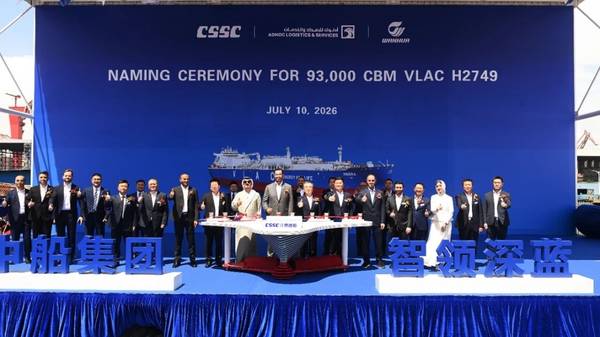
Areion vessel. Dorian LPG takes delivery of dual-fuel VLGC capable of carrying ammonia  

The 93,000-cbm Areion can run on LPG or fuel oil and transport ammonia cargoes.

FSRU Toscana alongside Green Zeebrugge vessel. RINA awards ISCC EU certification to OLT Offshore LNG Toscana for bio-LNG supply  

Certification enables bio-LNG use in the EU as a renewable fuel under RED II and RED III directives.

World Shipping Council at IMO meeting. WSC calls for safe maritime corridor as 20,000 seafarers remain trapped in the Persian Gulf  

Industry body urges IMO member states to establish safe passage and supply access.

Graphic promoting Auramarine webinar titled 'Sustainable Fueling Part 3: Ammonia - next alternative fuel in marine'. Auramarine to host webinar on ammonia as marine fuel in April  

Finnish firm will explore ammonia’s role in maritime decarbonisation at its third spring webinar.

Front cover of study by WinGD and Envision Energy titled 'Renewable Fuel Economics: An OPEX illustration based on current costs'. Green ammonia could reach cost parity with VLSFO and LNG by 2050, study finds  

WinGD and Envision Energy study projects green ammonia operational costs competitive with conventional marine fuels.

Elenger Marine's LNG bunkering vessel Optimus alongside Brittany Ferries’ Saint-Malo. Bureau Veritas verifies methane emissions on Brittany Ferries’ LNG vessels  

Verification enables ferry operator to report measured methane slip instead of regulatory default values.

Map showing existing and planned Emission Control Areas (ECAs). Alliance calls for urgent black carbon action as new Arctic emission control areas take effect  

Canadian Arctic and Norwegian Sea ECAs now in force, with compliance deadline set for March 2027.

Artistic impression of battery-electric ferry for operation on Perth’s Swan River. Lloyd’s Register to class Western Australia’s first electric ferry fleet  

Echo Marine Group partners with Lloyd’s Register on five battery-electric ferries for Perth’s Swan River.

Thomas Kazakos, secretary general of The International Chamber of Shipping (ICS). ICS condemns Middle East shipping attacks as 20,000 seafarers remain trapped  

Industry body calls for urgent state action to resupply vessels and enable crew changes.

Molslinjen ferry illustration. Molslinjen order propels Australia to top of battery vessel production rankings  

Danish ferry operator’s three-catamaran order at Incat Tasmania shifts global manufacturing landscape, analysis shows.