Italian owner
Ignazio Messina & C. has selected
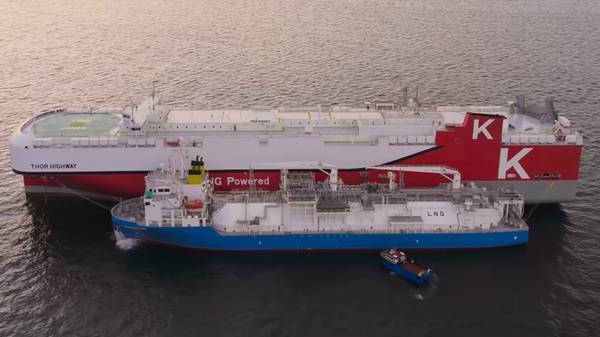
Hamworthy Krystallon seawater scrubbers so that four new 45,000 dwt ro-ro ships burning residual fuel oil can meet rules demanding sulphur emissions, equivalent to just 0.1% sulphur content.
The ships, under construction at
Daewoo Shipbuilding and Marine Engineering, South Korea, will be available to trade worldwide, although their principle area of operation will be in the Mediterranean Sea.
EU directive EC 2005/33, introduced in January this year, imposes a 0.1% limit on sulphur emitted by ships in EU ports, achievable through burning low sulphur content fuel (MGO) or fitting abatement technology.
"These ships are being built with the highest environmental standards in mind," said Dott. Ing.
Enrico Allieri, Technical Director, Ignazio Messina. "This is demonstrated by the fact that they are the first ships of their type to feature RINA's Green Plus notation. The installation of seawater scrubbers to control emissions is critical to our overall environmental objectives. In addition it makes great economical sense."
Each ship will feature five scrubbers, consisting of four units for the auxiliary engines (each 2 MW) and one unit for the auxiliary boiler (2.5 tons steam per hour). All scrubbers will be housed within the ship funnel casings.
Equipment will also include a control system, combined wash-water treatment plant and a new range of super duplex stainless steel pumps supplied by Hamworthy's Singapore plant. All emissions will be continuously monitored.
Burning fuel with a sulphur content of up to 4.5%, the ships will nonetheless still be able to meet the 0.1% EU's in-port emissions requirement.
Sigurd Jenssen, Managing Director, Hamworthy Krystallon Ltd, said: "This is an important milestone for Hamworthy Krystallon, but also for exhaust gas scrubbing in the marine industry in general. Messina, DSME and Hamworthy are all leading names in the shipping industry, demonstrating our collective view that seawater scrubbing will become a mainstream marine technology."
As part of the build project, provision is also being made for the future installation of scrubbers to cut emissions from the ships' main engines, in line with operation in the Emissions Control Areas defined by IMO, where maximum sulphur content in ship fuels is capped at 1% from July 1st 2010, falling to 0.1% from 2015.
To date, Hamworthy Krystallon seawater scrubbers have been successfully trialled on the
P&O Ferries ship
Pride of Kent and on the
Holland America Lines cruise ship
Zaandam. It is also a feature of land-based installations in Greece and Japan.
Hamworthy beat off a number of suppliers to secure the breakthrough deal. "Our choice was based on the track record of the Hamworthy Krystallon system, but also on the support available from a global marine group like Hamworthy in committing to technology that is new to us as a shipowner," said Dr. Allieri.
"Of course, we take pride in securing an industry first," said Mr Jenssen. "However, we also know that viable competing technologies will be critical to the wider uptake of seawater scrubbing by other forward looking shipowners."
"Shipowners operating under the new European regulations can now be assured that a technology based on proven components and which meets both current and planned rules, is commercially available This allows a single-fuel ship design, requiring no additional tanks and fuel treatment systems," said Mr Jenssen. As with our other marine products, the seawater scrubbing plant has been designed with the same ‘on/off' ease of operation in mind and involves no moving parts."