Thu 25 Oct 2018, 13:48 GMT

Balearia to build gas-powered, high-speed catamaran


Aluminium cutting scheduled for December; entry into service slated for the summer of 2020.


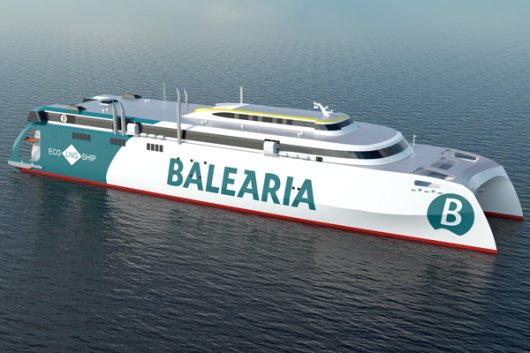
Rendering of Balearia's latest LNG-powered, high-speed catamaran, which will be equipped with two LNG storage tanks - enabling it to travel 400 nautical miles without refuelling.
Image credit: Balearia
Balearia has announced that it is shortly due to commence the construction of its first gas-powered, high-speed catamaran, which the company claims will also be the world's longest and highest-capacity fast ferry catamaran.

The 125-metre-long vessel is to be built at the Armon shipyard in Gijon, northern Spain, in a project costing EUR 90m, with aluminium cutting scheduled to commence in December and the ferry's entry into service slated for the summer of 2020.

According to Balearia, the vessel will be propelled by four Wartsila dual-fuel LNG/diesel engines each delivering 8,800 kilowatts (kW).

The catamaran will also be equipped with two LNG storage tanks, enabling it to travel 400 nautical miles without refuelling.

"The use of liquefied natural gas allows us to fulfil our commitment to the environment and energy efficiency, while also remaining one step ahead of the new pollutant gas reduction regulations scheduled for 2020," said Balearia president Adolfo Utor.

As previously reported, Balearia is also building two new, dual-fuel, gas-powered ferries at the Cantiere Navale Visentini shipyard in Italy. The first is expected to be operational from next February.

And the LNG-fuelled ferry that was ordered in 2016 from Construcciones Navales del Norte SL (LaNaval) shipyard in Sestao, Spain, is scheduled to enter into regular service in 2019.

Meanwhile, the first of a number of LNG retrofits is due to take place this autumn. Balearia had previously announced that the conversion programme would be for five of its existing vessels (Bahama Mama, Martin i Soler, Naples, Sicily and the previously retrofitted Abel Matutes), whilst on Thursday the company said that, in fact, six ships would now be converted to gas propulsion.

Balearia has also upped the estimated cost of the retrofit project from EUR 60m to EUR 72m. It follows the confirmation on October 10 that the European Union had awarded a grant of EUR 11.8m towards the project, which at the time was said to be 20 percent of the total cost.

Balearia notes that it plans to have at least half of its ferry fleet running on LNG within the next three years, and all of its ships using the gas fuel by 2028.

The Spanish ferry operator currently has 30 vessels in its fleet, 26 of which are owned.


Grande Pacifico vessel. Grimaldi takes delivery of ammonia-ready Grande Pacifico  

9,800-ceu ship is the largest PCTC in the Neapolitan Group’s fleet and the first of five sister vessels on order.

Regional seminar on alternative fuels and new technologies. IMO seminar in Trinidad and Tobago trains Caribbean maritime educators for the alternative fuels era  

A five-day regional seminar in Port of Spain addressed ammonia, methanol and hydrogen training for seafarers.

Summit Arbutus vessel. Corvus Energy wins 40 MWh battery contract for BC Ferries’ new biofuel-compatible Summit Class vessels  

Norwegian battery supplier to power four new hybrid-electric ferries for Canada’s BC Ferries.

Fleetzero Leviathan Battery Energy Storage System (BESS). ABS issues product design assessment for Fleetzero’s Leviathan battery system  

The first US-manufactured lithium iron phosphate marine battery system receives classification society approval.

Grand Tour vessel render. ABB wins power and propulsion contract for Allseas’ offshore wind support vessel  

ABB will supply an integrated propulsion package for a new semi-submersible vessel supporting Europe’s offshore wind sector.

Keel-laying ceremony for SGC 005. Pinnacle Marine lays keel for fifth B100-compatible harbour craft as Singapore fleet build-out reaches full construction phase  

All five vessels in Pinnacle Marine's B100-compatible utility boat programme are now under construction.

210,000-tonne tri-fuel ore vessel render. CSSC units sign contract for four tri-fuel ore carriers  

Ships feature a tri-fuel propulsion system combining ethanol, methanol and fuel oil.

Houston skyline. Bunker One seeks oil derivatives trader for Houston desk  

New hire to work alongside trading and sales, providing hedging solutions for physical exposure.

Lyla Pathfinder vessel. Kawasaki delivers 13th LPG-fuelled LPG/ammonia carrier  

86,700-cbm vessel is shipbuilder's 20th delivery featuring LPG-fuel propulsion.

Mein Schiff Relax ship-to-ship (STS) bunkering operation. TUI Cruises puts both InTUItion-class ships on bio-LNG as fleet targets 50,000-tonne CO₂e saving in 2026  

German cruise operator says bio-LNG use across two newbuilds has already cut 26,000 tonnes of CO₂e.