Thu 7 Jun 2018, 12:18 GMT

Balearia launches ferry with scrubber system


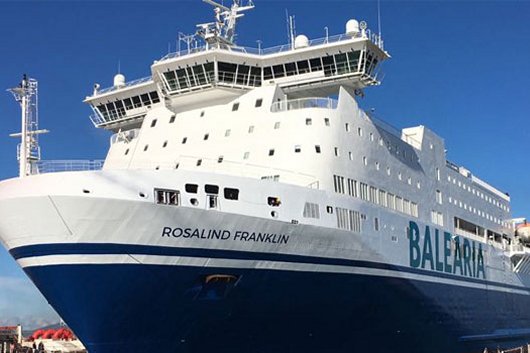
The Rosalind Franklin will operate between Barcelona and Palma de Mallorca.


Balearia's ferry, the Rosalind Franklin, is fitted with an exhaust gas cleaning (or 'scrubber') system.
Image credit: Balearia
Balearia has incorporated the ferry Rosalind Franklin to the Barcelona-Palma de Mallorca route. The vessel features an exhaust gas cleaning (or 'scrubber') system.

With the scrubber solution installed, the new ship will be able to reduce exhaust gas sulphur oxide emissions to below 0.1 percent, meeting both existing Emission Control Area (ECA) standards and those of the upcoming 0.5 percent global sulphur cap in January 2020.

The 188-metre-long ferry has a sailing speed of 22 knots and will be leaving from the port of Barcelona on a daily basis at 23:00 hours, and from Palma at 12:30 hours, with a journey time of around seven-and-a-half hours.

Last year, Balearia invested EUR 125 million in acquisitions, new vessel construction and repowering as the company continued to focus on improving the fuel efficiency of its fleet and in the development of LNG-powered ferries.

The first in a series of four eco fast ships, the Eco Aqua, started operating between the islands of Ibiza and Formentera last year. The second, Eco Lux, began transporting activities last month, whilst the remaining two ships - Eco Terra and Eco Aire - are expected to commence operations shortly.

The fuel-saving ships are powered by state-of-the-art engines designed to minimize emissions and feature a wave-piercing bow and photovoltaic solar panels, supplying energy on board.

In terms of LNG developments, last year, Balearia ordered two new, dual-fuel, gas-powered ferries to be built at the Cantiere Navale Visentini shipyard in Italy. The vessels are expected to be operational by the end of 2018.

In January 2017, the company's 2010-built Abel Matutes was refuelled with LNG in Barcelona for the first time after being retrofitted with a 30-cubic-metre LNG storage tank and an auxiliary natural gas engine built by Rolls-Royce.

Balearia's fourth LNG-fuelled ferry, which was ordered in 2016 from Construcciones Navales del Norte SL (LaNaval) shipyard in Sestao, Spain, is scheduled to enter into regular service in 2019.

Christiania Energy headquarters. Christiania Energy relocates headquarters within Odense Harbour  

Bunker firm moves to larger waterfront office to accommodate growing team and collaboration needs.

AiP award ceremony for 20K LNGBV design. HD Hyundai Heavy Industries receives design approval for 20,000-cbm LNG bunkering vessel  

Bureau Veritas grants approval in principle following joint development project with South Korean shipbuilder.

Lloyd’s Register technical committee meeting in Spain. Peninsula outlines dual role in FuelEU Maritime compliance at Lloyd’s Register panel  

Marine fuel supplier discusses challenges for shipowners and opportunities for suppliers under new regulation.

Current status of fleet fuel types chart. LNG-fuelled container ships dominate January alternative-fuel vessel orders  

Container ships accounted for 16 of 20 alternative-fuelled vessels ordered in January, DNV reports.

Rick Boom, CIMAC and Professor Lynn Loo, GCMD. GCMD and CIMAC sign partnership to advance alternative marine fuel readiness  

Two-year agreement aims to bridge operational experience with technical standards for decarbonisation solutions.

Renewable and low-carbon methanol project pipeline chart as of January 2026. Renewable methanol project pipeline reaches 58.2m tonnes by 2031, GENA reports  

Project Navigator Methanol tracks 275 projects, including e-methanol, biomethanol and low-carbon methanol facilities globally.

Petrobras logo. Petrobras adjusts bunker pricing and minimum order volumes at Santos  

Brazilian supplier discontinues volume discount tier and lowers minimum order quantity from 1 March.

Viking Grace vessel. Viking Line secures biogas supply for 2026 after tenfold increase in biofuel use  

Åland-based ferry operator aims to maintain 50% biogas blend throughout the year on two vessels.

GNV Aurora vessel. GNV takes delivery of second LNG-powered vessel Aurora from Chinese shipyard  

Vessel to enter service on Genoa–Palermo route in April, completing first fleet renewal phase.

Tangier Maersk vessel. Maersk takes delivery of first methanol-capable vessel in 9,000-teu series  

Tangier Maersk is the first of six mid-size container ships with methanol-capable dual-fuel engines.