The Valenciaport Foundation for Research, Promotion and Commercial Studies of the Valencian region,
Fundación Valenciaport, has today confirmed that the
GAINN projects - two initiatives (
GAINN4MOS and
GAINN4SHIP INNOVATION) that are coordinated by the Fundación Valenciaport and co-financed by the European Commission through the Connecting Europe Facility (CEF) programme - are to include actions focused on analysing and identifying the optimal solution that would enable ports to provide LNG supply services, as well as actions aimed at designing and building LNG supply facilities.
The projects are to also include engineering studies on adapting ships to reduce their emissions to "desired" levels, pilot tests to retrofit and improve various types of vessels, and actions to retrofit or build new vessels that comply with this framework, Fundación Valenciaport said.
In a statement, Fundación Valenciaport stated: "The GAINN projects will promote sea and land transport that is greener, more secure and more sustainable. They will do so by reducing operating costs associated with fuel consumption by 30 percent, through prototype retrofits of the ships forming part of the projects. They will also reduce CO2 emissions by about 20 percent and sulphur emissions by 80 percent."
GAINN4MOS
GAINN4MOS was set up to improve the Motorways of the Sea network in six Member States (Spain, France, Croatia, Italy, Portugal and Slovenia) by carrying out engineering studies on ship retrofitting and/or construction, port LNG infrastructure, bunkering stations and pilot projects.
GAINN4MOS includes 14 detailed engineering studies on LNG infrastructure and bunkering stations, retrofitting and construction of vessels and 11 prototypes (4 LNG retrofitted prototype vessels and 7 LNG bunkering stations at core ports).
Its specific objectives include:
- To provide the core ports of Koper, La Spezia, Venezia, Fos-Marseille and Nantes - Saint Nazaire, with initial pilot infrastructures in the cases of Koper and Italian ports and with fully operational LNG break-bulking stations in Fos-Marseille and Nantes-St Nazaire required to comply with Directive 2014/94/EU on the deployment of alternative fuels infrastructure.
- To generate an initial demand for the Italian LNG bunkering infrastructures with the retrofitting/newbuilding of one pax or ropax vessel included in this project.
- To foster greener, safer and sustainable maritime transport by reducing operational costs associated with fuel consumption on average by 30% with the retrofitting/newbuilding of 4 prototype vessels included in this proposal.
- To reduce CO2 emissions by 20% (on average) and sulphur emissions by 80% (on average) with the retrofitting/newbuilding of 4 prototype vessels included in this proposal.
- To contribute to the development of the European Union LNG and maritime industry and shipyards: at least 200 employees in 4 European shipyards and 30 additional employees in sea carriers will be working in the retrofitting/newbuilding of 4 prototype vessels and in the vessels themselves.
- To contribute to the development of the European Union LNG industry at ports: at least 35 employees will be working directly in 3 pilots and 2 fully operational LNG infrastructures or bunkering stations in core ports included in the GAINN4MOS Action.
- To share results obtained with at least 30 EU ports and 20 sea carriers not participating directly in this proposal via 8 large scale communication events and by their participation in the Stakeholders Interest Group.
GAINN4SHIP INNOVATION
GAINN4SHIP INNOVATION aims to retrofit a large high-speed craft (HSC) ropax vessel so that it will be fuelled by a mix of LNG and diesel.
The participating partners in GAINN4SHIP INNOVATION are Valenciaport Foundation as coordinator; the Port Authority of Valencia, Fred Olsen, The International Center for Numerical Methods in Engineering (CIMNE) and Spain's Ministry of Development.
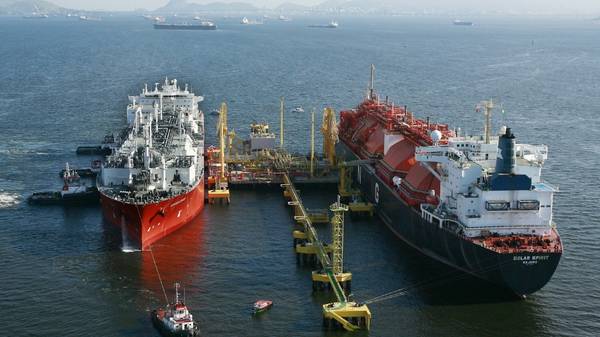
Image: Boluda's Spabunker Cuarenta bunkering barge, one of the vessels to be retrofitted within the GAINN4MOS project.