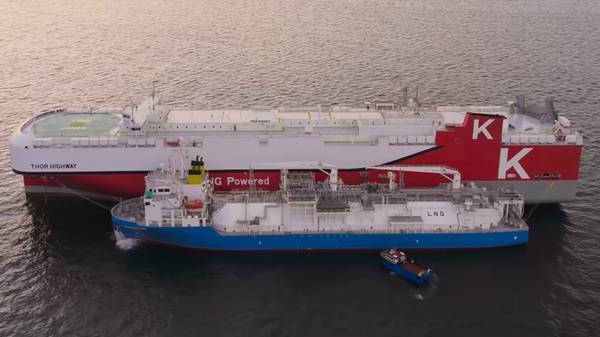
Source: Port of Rotterdam, September 26
Chemgas reinforces position with unique dual-fuel LNG tanker
The increasing use of LNG (liquefied natural gas) as a fuel was given another boost with today’s commissioning of a new type of inland navigation vessel,
Sirocco [pictured].
Owned by
Chemgas Barging, this conventional gas tanker is equipped with a main engine capable of running on marine gas oil as well as on the clean LNG. What makes this dual-fuel system unique is that it is positioned below decks in the cargo area, which improves vessel safety. This deployment is part of the ‘
LNG Masterplan Rhine-Main-Danube’ project which is being realised with the support of the
European Commission’s TEN-T Programme under the coordination of
Pro Danube Management GmbH and the
Port of Rotterdam Authority.
With almost fifty years of experience and expertise in the transport of liquefied petro-chemical gasses, Chemgas played a leading role in designing and developing Sirocco. Chemgas will deploy Sirocco for the transportation of conventional gasses for customers throughout the Rhine basin. The vessel was officially christened today in Grevenmacher, Luxembourg, by Mrs. Claudette Majerus, the wife of François Bausch, Minister of Sustainable Development and Infrastructure in Luxembourg. Among those attending the christening were the board members of Chemgas Barging and delegations from the European Commission (represented by the
Innovation and Networks Executive Agency - INEA).
Dual-fuel
The conventional gas tanker Sirocco is equipped with a main engine capable of running on LNG as well as on marine gas oil. Considering the fact that currently the supply chain of LNG in Europe is still limited, the use of this dual-fuel concept ensures full operational availability of the vessel. In addition, the tanker has two gas generators which use the clean LNG as an energy source.
Below decks
Sirocco is the first newly built inland navigation tanker in which the LNG fuel tank is located below decks inside the cargo area. This construction itself further increases the safety of LNG as a fuel. The dual-fuel engine concept enables Sirocco to optimise LNG consumption to 99%. With LNG as a fuel, NOx particles and CO2 emissions are substantially reduced. As part of the LNG Masterplan project, the emission values of the engine will be actively monitored for a certain period of time in order to verify that emission reductions are indeed achieved.
LNG Masterplan for Rhine-Main-Danube
The gas tanker Sirocco was developed as a part of the EU-supported LNG Masterplan Rhine-Main-Danube project. The LNG Masterplan aims to promote LNG as a fuel and cargo for the inland navigation industry. It also formulates and enforces the necessary (safety) regulations for the use and transport of LNG. The LNG Masterplan is supported by a 40 million euro European Commission grant through the TEN-T Programme and is implemented by a consortium of 33 companies and organisations from the public and private sectors from twelve European member states. The project is supervised and coordinated by Pro Danube Management GmbH and the Port of Rotterdam Authority.
About the Chemgas group
Chemgas is based in Rotterdam, the Netherlands. Since 2003, the company is part of the Jaegers Group from Germany. Chemgas was founded in 1965 as a barging company, specialized in the transportation of liquefied petroleum products (LPG) on the inland waterways of Europe, mainly on the Rhine up to Basel and in the ARA-area (Antwerp-Rotterdam-Amsterdam area). Later, also sea going activities were deployed with a focus on the North Sea but also venturing out to the Baltic and Mediterranean Sea. The inland fleet is operated via the Luxembourg entity Chemgas Barging. Together with the French partner CFT an additional 5 inland gas tankers are operated on the river Rhine. The fleet is operated to the highest technological and safety standards. The majority of the fleet is owned and crewed by Chemgas. The combined transported volume amounts to approximately 3 million tons of cargo per year.
About the Jaegers group
The Jaegers group is one of Europe’s largest inland navigation companies. Relying on almost one hundred years of experience and with extensive expertise in innovative shipping concepts, Jaegers provides tanker transport services between the North Sea and the Black Sea. The Jaegers group operates a fleet of approximately one hundred and forty vessels, excluding the fleet of its subsidiary Chemgas. The group transports various types of liquid chemical and oil products for trading companies and the chemical and petrochemical industries.
Image: Sirocco inland navigation vessel - powered by LNG.