General Dynamics NASSCO has commenced the construction of five LNG-conversion-ready tankers for
American Petroleum Tankers (APT) at its shipyard in San Diego, United States.
Speaking at a steel cutting ceremony for the first tanker, the
APT-1,
Kevin Graney, vice president and general manager of
General Dynamics NASSCO, said: "Today's start of construction ceremony signifies our ongoing relationship with American Petroleum Tankers. NASSCO is pleased to continue our commitment as good environmental stewards by building the most energy-efficient tankers in the Jones Act fleet and in helping to sustain and grow highly-skilled jobs right here in San Diego."
The APT-1 is the first tanker of a five-tanker contract between General Dynamics NASSCO and APT, which calls for the design and construction of five 50,000-deadweight-tonne (dwt), LNG-conversion-ready product carriers with a 330,000-barrel cargo capacity. The 610-foot-long tankers are a new 'Eco' design. They are said to offer improved fuel efficiency, and include the latest environmental protection features, including a ballast water treatment system.
The five-tanker APT contract, along with NASSCO’s existing backlog, will sustain its current workforce of more than 3,000 and will add approximately 500 jobs at the firm, NASSCO said.
"This is a great opportunity to create hundreds of jobs in our burgeoning blue-tech industry," San Diego Mayor
Kevin Faulconer said at the steel cutting ceremony. "By adding these good-paying jobs, NASSCO expands its role as a pillar of San Diego’s defense and innovation economies."
The ships were designed by
Daewoo Ship Engineering Company (DSEC), a subsidiary of
Daewoo Shipbuilding & Marine Engineering (DSME) of Busan, South Korea.
According to NASSCO, the new vessels will include improved fuel efficiency through several features, including a G-series
MAN ME slow-speed main engine and an optimized hull form. The tankers will also have dual-fuel-capable auxiliary engines and the ability to accommodate future installation of an LNG fuel-gas system.
The Eco-class tankers represent the continuation of NASSCO's partnership with DSEC, which was a partner on the five APT State-class product tankers and currently is contributing to two LNG-powered containerships for
TOTE Shipholdings, Inc.
"We are very pleased to get the construction phase of this exciting project underway and appreciate the commitment of our customers, which facilitated this fleet expansion through their long-term charter support,” said
Rob Kurz, vice president of
Kinder Morgan Terminals and president of
Kinder Morgan Energy Partners, L.P. (KMP) subsidiary APT. "We look forward to taking delivery of these state-of-the-art vessels."
NASSCO added: "The new construction and operation of the new vessels are aligned with the Jones Act, which requires that ships carrying cargo between U.S. ports be built in U.S. shipyards."
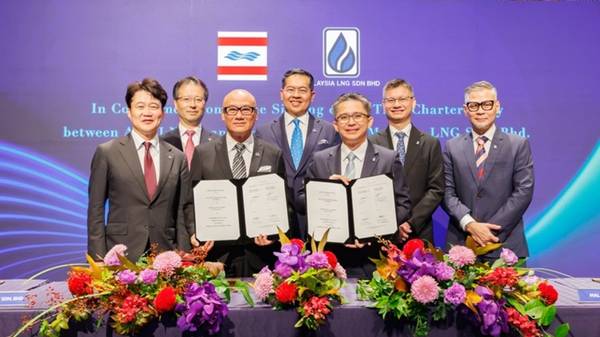
Image: Steel cutting ceremony for the APT-1 tanker at the General Dynamics NASSCO shipyard in San Diego, United States.