This is a legacy page. Please click here to view the latest version.
Wed 7 Apr 2021, 15:34 GMT

World's first hydrogen cargo vessel set for Paris launch


Plan to have newbuild running on hydrogen by the end of 2021.


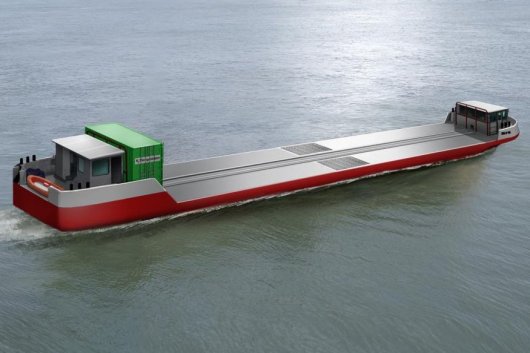
Illustration of the Flagships project vessel, set to be the world's first commercial cargo transport vessel to operate on hydrogen.
Image: Flagships
The innovation project Flagships is set to deploy the world's first commercial cargo transport vessel to run on hydrogen within the next few months.

A hydrogen-powered vessel owned by French inland shipowner Compagnie Fluvial de Transport (CFT), a subsidiary of Sogestran Group, is due to begin commercial operations along the river Seine in Paris later this year.

The vessel will operate on compressed hydrogen produced from electrolysis, enabling zero-emission operations.

The power generation system is supplied by ABB Marine & Ports, with fuel cells from Ballard. LMG Marin, meanwhile, is responsible for the vessel design, with hydrogen provided by local suppliers in the Paris region.

Funding and project development

The Flagships project was awarded EUR 5m of funding in 2018 from the EU's research and innovation programme Horizon 2020, under the Fuel Cells and Hydrogen Joint Undertaking (FCH JU) - a public-private partnership supporting research, technological development and demonstration (RTD) activities in fuel cell and hydrogen energy technologies in Europe - to deploy two hydrogen vessels in France and Norway.

The project's initial plan was to deploy a hydrogen push boat in the Lyon area, but as the broader potential for hydrogen in cargo transport emerged, the demo pusher was changed to an inland cargo vessel. The new vessel will instead be tasked with moving goods on pallets and in containers along the river Seine.

The shift in focus to an inland cargo vessel was based on the experience gained by Sogestran in Belgium, where Blue Line Logistics (BLL), another of its subsidiaries, operates three cargo vessels sailing under the concept name 'Zulu'.

One Zulu vessel has also been put into operation in Paris, and an additional two Zulu ships are currently under construction for the same market.

The Flagships project will install a hydrogen power generation system on one of the newbuilds, scheduled for delivery in September 2021.

Blue Line Logistics plans to have the ship operating on hydrogen before the end of 2021.

Commenting on the milestone project and the future, Bart Biebuyck, Executive Director at FCH JU, observed: "As we move through the energy transition, hydrogen technologies are gaining traction in the maritime sector. Flagships is a very exciting project for us, since it is leading the way to demonstrate how vessels operating on green hydrogen can decarbonise urban rivers. By translating technological innovations into commercial operations we can make zero-emissions inland vessels a reality in every European city!"

Flagships consortium

The Flagships consortium includes 12 European partners, with two shipowners - France's CFT and Norled of Norway - assisted by French support companies Sogestion and Sogestran.

The maritime OEM and integrator companies are Finnish firm ABB Marine & Ports and Norway's Westcon Power & Automation, whilst LMG Marin is responsible for the ship design.

Fuel cell technology is provided by Denmark-based Ballard Europe, with vessel energy monitoring and management by France's Pers-EE.


Nicklas Mikkelsen, Malik Supply. Malik Supply hires first trader for new Dubai office  

Nicklas Mikkelsen joins Danish bunker supplier ahead of January 2026 launch.

Tallink’s MyStar vessel. Tallink's MyStar joins Gasum's FuelEU Maritime compliance pool using bio-LNG  

Nordic energy company Gasum signs pooling agreement with Elenger to generate compliance surplus.

Methane Abatement in Maritime Innovation Initiative (MAMII) speakers. Maritime coalition gathers in Brussels to advance methane measurement and abatement technologies  

MAMII convenes shipowners, engine makers, and policymakers to accelerate methane reduction from LNG-fueled vessels.

Green oil bubbles. BIMCO delays biofuel clause for time charters to spring 2026  

Maritime organisation pushes back publication to address safety, technical requirements, and industry feedback.

Group photo of participants at the REMPEC expert meeting. Mediterranean moves closer to nitrogen oxide emission controls  

Expert meeting endorses feasibility study with 2032 target for Med NOx ECA implementation.

Seaboard Venture naming ceremony. Sanfu Shipbuilding delivers final 3,500 TEU dual-fuel container ship to US owner  

Taizhou-based shipyard completes first batch of LNG-powered vessels with "zero accidents, zero delays".

Aerial view of a container vessel. FuelEU Maritime regulation reshapes ship management contracts, DNV says  

DNV's Emissions Connect aims to provide neutral data for commercial negotiations under new rules.

Illustration of Scales of Justice with cargo ship and penalty block. FuelEU penalties spark contract disputes as first-year compliance costs emerge  

Shipowners and charterers negotiate biofuel handling, payment timing, and multiplier penalties under new regulations.

Marina Bay Sands, Singapore. Singapore tops first global container port ranking by DNV and Menon Economics  

The port leads across all five assessment pillars in inaugural industry report.

Jack Spyros Pringle, Lloyd’s Register. Marine fuel procurement becomes strategic imperative as regulatory pressures mount: LR  

Operators must adopt comprehensive fuel strategies amid supply constraints and compliance costs, says Lloyd's Register.


↑  Back to Top


 Recommended