Cargo throughput at the
Port of Rotterdam rose by 3 million tonnes, or 0.7 percent, to 433 million tonnes in 2011 in a comparison with the previous year.
Supply grew by 0.8% to 308 million tonnes and distribution by 0.7% to 126 million tonnes. More agribulk (+18%), coal (+12%), other dry bulk (+7%), other liquid bulk (+2%), containers (+10%), roll-on/roll-off (+4%) and other general cargo (+13%) were handled this year compared to 2010. There was, however, a decrease in throughput of iron ore and scrap (-6%), crude oil (-8%) and mineral oil products (-6%).
Commenting on the results,
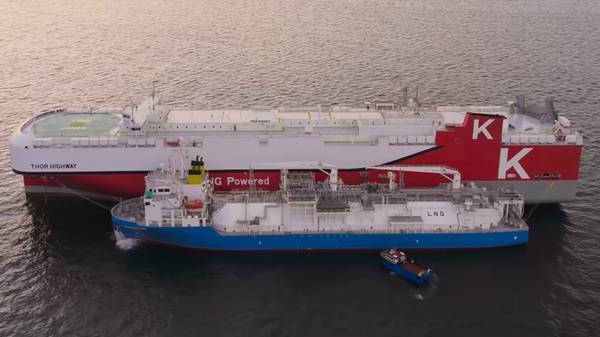
Hans Smits, Port of Rotterdam Authority CEO: “We are recording growth for the ninth time in ten years, in spite of the disappointing economy and the fall in growth of throughput since November in the port. This demonstrates the importance of ongoing investment in capacity and new activities, such as the storage of LNG and the production of bio-ethanol. The largest growth areas were transhipment of containers, coal and agribulk.
"Throughput in the port is strongly-connected to developments in relevant world trade and German industrial production. On the basis of this, we expect to maintain the current level next year. In the second half of the year, I expect that we will have put the European confidence crisis behind us. Businesses and the Port Authority will continue investing in such things as Maasvlakte 2, container and tank terminals, because we also expect reasonable growth as from 2013”.
Liquid bulk
The throughput volume of liquid bulk fell by 6% to 179 million tonnes. Supply of crude oil dropped by 8% to 92 million tonnes.
According to Rotterdam Port Authority, refinery production was low this year due to high oil prices and low demand for products in Northwest Europe. The minimal-to-negative refinery margin resulted in some of the major repairs being transferred to this year. This meant that imports fell to a historically low level.
The supply of oil products shrank by 3% to 42 million tonnes and distribution by 10% to 31 million tonnes. In total, 73 million tonnes (-6%) were handled in 2011. The decline was mainly attributed to the release of floating storage in 2010. This involved a large amount of gas oil/diesel.
The
supply of fuel oil, in volume the largest product, increased slightly in 2011. In contrast, paraffin imports and petrol exports fell.
The throughput of other liquid bulk rose slightly, by 1% to 32 million tonnes. The European chemical industry grew slightly, with a decline towards the end of the year. In the bulk chemical sector, more methanol was handled, both incoming and outgoing. High prices resulted in a reduction in palm oil imports. The import of rapeseed oil (from France and Canada) increased because of the disappointing German crop. Throughput of biofuels decreased, mainly because of the decline in Brazilian bio-ethanol production.
Dry bulk
The total amount of dry bulk handled this year increased by 3% to 87 million tonnes.
Throughput of coal increased by 12% to 27 million tonnes. The closure of blast furnaces led to a reduction in demand for coking coal, and mine closures meant a further fall in German supplies. Demand for energy coal, 60% of Rotterdam’s total, remained below expectations for the first 9 months because of Germany’s use of wind, solar and nuclear energy from France and the Czech Republic. Following the decision to disconnect the German nuclear power stations, demand for coal increased quickly and dramatically. A stabilization in coal throughput is expected next year, Rotterdam Port Authority said.
Throughput of ore and scrap fell by 6% to 38 million tonnes. In the first half of the year supply was poor because 2010 stores were being used. Distribution to the hinterland was at usual levels. In the second half of the year, steel production was scaled down, including the closure of blast furnaces in Liège, Florange and Eisenhüttenstadt. A further reduction is expected. Rotterdam Port Authority said the effect on throughput so far has been limited because throughput towards the end of 2010 was also low due to high stores.
Other dry bulk (minerals, ore concentrates, construction materials) grew by 7% to 13 million tonnes. The largest users of this segment, the chemical and the metals industry, maintained a continued high level of production. The third largest customer, the building sector, remained weak. Throughput of biomass increased by a few hundred thousand tonnes. Rotterdam is now estimated to have a share of approximately 30% in the Western-European import of wood pellets. An exceptional amount of (grit) salt was imported in 2011.
Throughput of agribulk (grain, oil seeds, derivatives) increased by 18% to 10 million tonnes. The disappointing European rape seed and wheat crop, in combination with a Russian export ban in the first six months, resulted in increases in imports by sea. The temporary reduction of import tariffs on food grain also contributed to this. Also important was the start of the Abengoa bio-ethanol factory, for which, just by sea, 600,000 tonnes of grain had already been supplied. An unknown quantity arrived by train from the European hinterland.
Containers and breakbulk
Container handling improved by 10% compared to last year. Growth in units from 20 foot was more than 6% to 11.9 million TEU. The difference indicates that fewer empty containers were handled.
Rotterdam further expanded its position in the largest trade route - between Europe and Asia. On this route, Rotterdam Port Authority said that more 10,000 – 15,000 TEU vessels are being used, which are able to enter Rotteram more easily than at competitor ports. Also, the transhipment directly linked to deep-sea vessels, especially those for the Baltics, continued to perform well. Throughput of intra-European containers, short-sea, grew slightly.
The roll-on/roll-off sector in Rotterdam focuses almost entirely on the British market, where the economy is seeing modest growth. This limited the growth in ferry services to 4% and throughput to a tight 18 million tonnes. Financial margins remain paper-thin, not least because of tough competition, also within Rotterdam.
Other general cargo continued to grow this year, by 13%. The tight 8 million tonnes of cargo comprises growth products: steel, metals (aluminium, copper etc.) and project cargo including paper and wood products, cars and fruit. The latter product is now being supplied largely by container.