Fri 28 Feb 2020, 14:51 GMT

World Fuel Services posts highest marine income since 2015


Despite drop in revenue and fourth consecutive annual decline in sales volume.


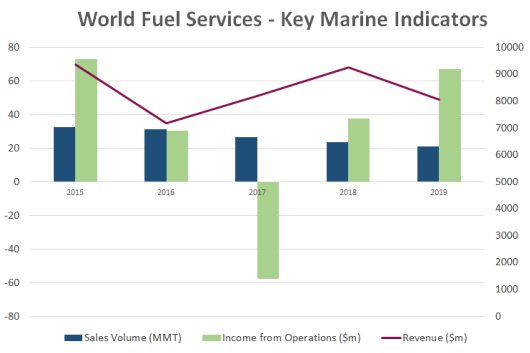
Image credit: Bunker Index. Source: World Fuel Services
World Fuel Services (WFS) reports that its marine segment posted an increase in income from operations of $29.3m, or 77.5 percent, to $67.1m in 2019 compared to the previous year.

The firm's annual gross profit of $181.5m, which was a year-on-year (YoY) rise of $35.7m, or 24.5 percent, was said to be mainly due to stronger performance in core resale operations.

The improvements in income and gross profit were achieved despite a YoY decline in marine revenue of $1.191bn, or 12.9 percent, to $8.059bn. Sales volume also fell over the 12-month period - by $2.8m, or 11.8 percent, to 20.9m tonnes.

In an analysis of performance over the last five financial years, the results show that WFS managed to find a way to adapt its business model to generate a marine income in 2019 similar to that achieved in 2015, but with far lower volume sold. Between 2016 and 2019, WFS, for the first time, had to contend with four consecutive annual declines in marine tonnage, and it posted successive reductions in marine earnings between 2016 and 2017 as the company went through a difficult period.

But this was followed by back-to-back increases in marine income between 2018 and 2019, resulting in a rise of $124.9m - from -$57m to $67.1m - in the space of two years. The 2019 figure was only just below the $73.0m result achieved in 2015, and this despite sales volume falling by more than a third (35.9 percent) - from 32.6m tonnes to 20.9m tonnes - over the same period.

Commenting on the results, Ira Birns, Executive Vice President and Chief Financial Officer, stated: "Our marine team did an outstanding job, driving increased profitability throughout 2019 by refining the core portfolio and a heightened focus on driving stronger returns."

Key Marine Performance Indicators: 2015-19

Year Sales Volume (MMT) Revenue ($m) Income from Ops ($m) Gross Profit ($m)
2015 32.6 9,367.2 73.0 189.6
2016 31.4 7,182.5 30.2 149.5
2017 26.5 8,199.3 -57.8 126.0
2018 23.7 9,249.5 37.8 145.8
2019 20.9 8,058.5 67.1 181.5
Fourth quarter

In the fourth quarter, WFS's marine segment posted an income from operations of $22.9m - a $15.9m improvement on the previous year. Gross profit climbed YoY by $15.3m, or 37.0 percent, to $56.6m - the highest level since the fourth quarter of 2014.

Revenue fell $291.2m, or 12.2 percent, to $2.091bn, whilst sales volume was down 16.4 percent to 5.1m tonnes from the previous year's figure of 6.1m tonnes.

Discussing performance, Birns remarked: "The significant year-over-year gross profit increase was principally related to strong results in core resale activity, driven in part by market volatility related to the new IMO standard and the transition from high-sulphur to low-sulphur fuel oil."

CEO Michael Kasbar said: "Our marine segment posted yet another quarter of outstanding results, closing out a year that produced the strongest annual marine earnings since 2015."

"The financial performance of our marine business in the fourth quarter is testimony to the value of our core reselling business and our growing network of strategic physical locations. Both activities complement each other and provide us with an unparalleled ability to manage risks and provide surety of supply."

Birns noted that almost 85 percent of marine fuel sold by WFS in the first quarter of 2020 is expected to be either low-sulphur fuel oil or marine gas oil (MGO) - up from around 55 percent in the last three months of 2019. This, according to the CFO, "should provide opportunities to again drive strong profitability in the first quarter [of 2020]" as prices remain significantly higher for these products than high-sulphur fuel oil.

Overall company performance

In its overall company results for 2019, WFS achieved a rise in net income of 51.2m, or 40.1 percent, to $178.9m as the aviation and land segments contributed with income from operations of $283.9m and $55.0m, respectively.

Gross profit climbed $93.5m, or 9.2 percent, to $1.112bn, whilst revenue fell $2.931bn, or 7.4 percent, to $36.819bn.

In Q4, meanwhile, net income jumped $26.9m, or 90.9 percent, to $56.5m.

MGO  

Suezmax crude oil tanker render. Guangzhou Shipyard secures Suezmax order, delivers vessels ahead of schedule  

China State Shipbuilding subsidiary reports nine vessel deliveries in the first quarter of 2026.

Clean ammonia project pipeline chart as of March 2026. Renewable ammonia pipeline grows despite Norway project freeze  

GENA Solutions tracks 325 projects totalling 146 MMT of capacity by 2034 despite execution challenges.

Antwerpen and Arlon naming ceremony. Exmar names world’s first ocean-going ammonia dual-fuel gas carriers in South Korea  

Two 46,000-cbm vessels can reduce CO₂ emissions by up to 90% during navigation.

Fujian province map with highlighted locations. Gulf Marine expands bonded lubricant supply network in China’s Fujian province  

Company adds supply points in Putian, Ningde and Fuqing, covering 20 terminals across the region.

Excelerate Acadia naming ceremony. Bureau Veritas classifies Excelerate Energy’s new 170,000-cbm FSRU Excelerate Acadia  

Vessel built by HD Hyundai Heavy Industries features dual-fuel engines and proprietary regasification system.

Osprey Energy logo. Osprey Energy seeks junior bunker trader to support Cebu trading activities from Netherlands  

Dutch marine fuel supplier targets Cebu region expansion through new training programme for Filipino candidates.

EUA prices dropping graphic. KPI OceanConnect highlights falling EUA prices as opportunity for shipowners to lock in compliance costs  

Marine fuel firm says timing carbon allowance purchases can reduce costs as EU emissions scope expands.

RINA employee in control room. RINA partners with Hanwha Group on battery-hybrid propulsion for ro-ro ferries  

Classification society to provide regulatory compliance verification for hybrid battery systems on newbuilds and retrofits.

Amadeus Titanium vessel. HGK Shipping’s Amadeus Titanium fitted with wind assistance system  

Coastal vessel equipped with VentoFoils at Dutch port to reduce fuel consumption on Covestro routes.

Sebastian Weder, Bunker One. Bunker One expands physical supply operations to Tallinn and Finland  

Marine fuel supplier extends Baltic Sea coverage with new operational presence in Estonia and Finland.