Stolt-Nielsen businesses
Stolthaven Terminals (Stolthaven) and
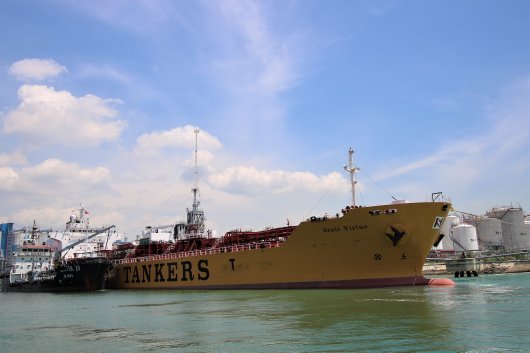
Stolt Tankers have jointly collaborated on the first concurrent bunkering operation at Stolthaven's facility in Jurong Island, Singapore.
On January 30, the chemical tanker
Stolt Virtue was able to refuel whilst berthed alongside the Stolthaven terminal at the same time as performing loading and discharging operations, Stolthaven has told Bunker Index.
Commenting on the landmark operation,
Bill Bryant, Managing Director of Stolt-Nielsen APAC & MEA, said: "Stolt-Nielsen continues to seek ways to drive efficiencies across all its assets. In the case of our tankers, time in port continues to be an area we are working to optimise. The ability to undertake more than one operation concurrently, which was carried out sequentially in the past, is a clear example of this focus in action."
In addition to bunkering, other operations can also be completed during the loading and discharging of cargoes, such as nitrogen purging of ship tanks, concurrent ship-to-ship (STS) operations and concurrent transshipment.
Chok Vui Shung, General Manager of Stolthaven Singapore, explained that the synergy of concurrent transshipment and bunkering offers potential cost savings for customers, improves ship turnaround times and increases safety because bunkering alongside can be better managed.
Furthermore, Vui Shung said the move to offer bunkering alongside was aligned with the Maritime and Port Authority of Singapore's (MPA) plan to close ALGAS anchorage for the expansion of Tuas Megaport.
Prior to Stolthaven Singapore's first concurrent bunkering operation, vessels calling at the facility refuelled by sailing to the anchorage.
Stolthaven informed Bunker Index that concurrent bunkering during terminal operations is to be made available to all ships in a move that is set to save time and improve efficiency.
"With the increasing challenges faced by vessels, we see that there are likely to be more concurrent bunkering operations at Stolthaven Singapore through 2018 and beyond. This service has been and will be extended to all vessels that are coming into Stolthaven Singapore for operations," the company noted.
Stolthaven also stressed that it was keen to ensure that only reliable, untarnished bunker suppliers were able to perform deliveries at its Singapore terminal.
"The suppliers shall be reputable and not negatively marked by [the] industry," the company commented.
The focus on safety was also highlighted by Bryant, who noted: "Whilst optimising the use of our assets is a clear driver, we would not do this at the expense of safety. Our driver for doing this at our own terminals is that we have all the specialised safety equipment for the safe handling of these chemicals at our terminals and therefore are very well placed to manage an incident were it to occur, though with calm waters and a managed situation, we minimize the risk of such an incident taking place in the first instance."
Stolthaven Singapore is a 230,300-cubic-metre-capacity independent storage terminal which mainly specializes in liquefied petroleum gas (LPG) and chemicals. It has 81 tanks ranging in size from 1,000 to 5,700 cubic metres.
There are three jetties available at Stolthaven Singapore that are all said to be suitable for concurrent bunkering operations.