The
Bomin Group today reaffirmed its commitment to providing physical bunkering products and services in the
Baltic, including
Rostock, Germany's largest Baltic port.
In line with the company's new regional hub structure, Bomin's Hamburg office will take responsibility for physical operations and infrastructure in the region.
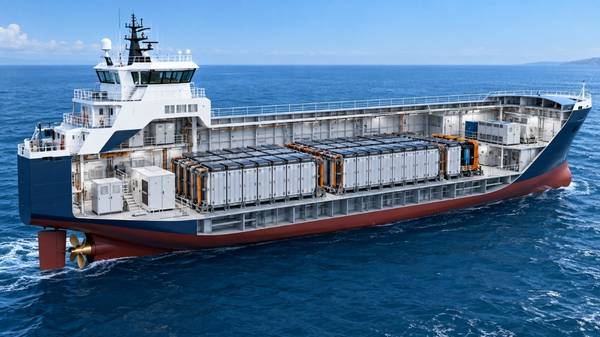
Bomin Deutschland is operating two state-of-the-art bunker barges in the Baltic area, MT
Bergen Troll and MT
Lioba, providing customers with a range of products including MGO DMA 0.1%, RMG 380 3.5%, RMD 80 0.1%, and RME 180 3.5%. The company will cover the ports of
Rostock,
Lubeck,
Travemunde and
Kiel, servicing customers in port, and via road, through its storage infrastructure and barge capacity in the region.
Commenting on the development,
Jan Christensen, Head of Global Bunker Operations, said: "Rostock is an important region for our customers, with real demand for a full spectrum of quality products, including MGO to ensure compliance within the Baltic Emissions Control Area. By controlling the operation from our German regional hub in Hamburg, in conjunction with our local physical supply and storage capabilities, we can ensure that our customers receive the highest quality of service standards, maximizing operational and cost efficiencies from order through to final delivery."
Regional hub restructuring
Bomin confirmed towards the end of last year that it had established a regional hub structure, with key offices in
Hamburg,
Houston,
Dubai and
Singapore supporting the company's offices and operations around the world. The restructuring resulted in Bomin
closing down its offices in Athens, London, Madrid, Rio de Janeiro, Tallinn and
Valencia.
Additionally, Bomin ceased its physical supply activities along the east coast of Spain and in Estonia, whilst in January, the company strengthened its physical operation in the Amsterdam-Rotterdam-Antwerp (ARA) region by time-chartering two bunker barges.
Competition in the Baltic
In January,
Aegean Marine Petroleum Network Inc. launched
a new service center in Rostock following the acquisition of
OBAST Bunkering & Trading GmbH, a physical bunker supplier and oil cargo trader. The new operation serves all German ports in the Baltic Sea and also covers southern Scandinavia.
LNG competition
In October last year, Bomin
sold its 50 percent shareholding in the joint venture LNG bunkering business
Bomin Linde LNG, which was
rebranded as Nauticor in April.
Today's commitment to Rostock comes two months after Bomin Linde completed its
first LNG bunker delivery in Rostock to the Fure West, a chemical and oil tanker owned by Swedish firm
Furetank Rederi AB.
The LNG supplier has
signed a letter of intent (LOI) with Furetank Rederi that will see Nauticor supply four ships using its new
gas supply vessel (GSV), which is scheduled to be delivered in 2018.
The 7,500-cubic-metre (cbm) GSV will be used to carry out the ship-to-ship LNG refuelling of ships, including ferries, cruise vessels and other shore-based gas consumers in the Baltic Sea.
Contact details for Bomin Deutschland's Baltic operation, are as follows:
Jens Reese
Tel.: +49 151 18 83 70 49
Przemek Baranowski
Tel.: +49 17 24 59 10 83
Email: physical[at]bomin.com
Image: The MT Bergen Troll during a bunker delivery operation.