American Bureau of Shipping (ABS), a provider of classification services to the global marine and offshore industries, has teamed up with partners
Arista Shipping,
Deltamarin,
GTT and
Wartsila in the '
Project Forward' joint development project (JDP) to develop a dry bulk carrier concept that employs liquefied natural gas (LNG) as fuel.
The aim of the project is to develop a Kamsarmax bulk carrier design to be the first of this type suitable for worldwide services powered by LNG in compliance with the International Maritime Organization's Energy Efficiency Design Index 2025 standards, NOx Tier III and Marpol Annex VI SOx emission levels. This landmark design would be the first LNG-fuelled cargo ship capable of full-range operations.
"The long-term potential for LNG as a marine fuel is tremendous," commented ABS Vice President of Global Gas Solutions,
Patrick Janssens in statement. "We see the near-term opportunities for larger vessels on fixed and known trade routes, but more opportunities will emerge as concepts mature and bunkering infrastructure expands. Environmental stewardship will continue to be a concern, and owners will be evaluating alternative fuel choices."
Arista Shipping Principal,
Alexander P. Panagopulos, remarked: "Project Forward represents a milestone for the shipping industry in bringing to the market a practical, achievable design for what are the workhorses of the shipping fleet. Our mission is to develop the next generation of energy-efficient and environmentally friendly dry bulk cargo ships to be sustainable worldwide beyond 2030. It marks a number of firsts and draws together the experience of a team of leaders in their field to make LNG-powered shipping a reality on the high seas."
Technical challenges in developing the design were considerable, as there is a need to carry a large volume of LNG (2,500 cubic metres) - which corresponds to full-range operation and 40 days - in a type of ship where available space is limited and cargo space is at a premium.
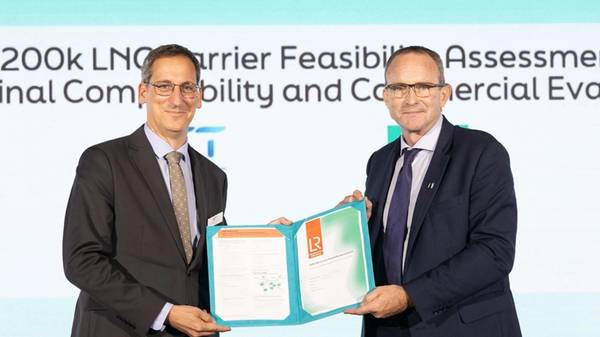
ABS is to provide approval in principle (AIP) for the concept, which is based on the Deltamarin B.Delta 82 design, utilizing a membrane LNG fuel tank developed by
Gaztransport et Technigaz (GTT).
The design also could be applied to other bulk carrier sizes and serve as the basis for an LNG-fuelled tanker, ABB says.
The concept features a Wartsila four-stroke, medium-speed engine without auxiliary generators. It is the first time this configuration has been applied to a vessel of this type, which is designed to simplify the vessel's engine room arrangement and contribute to lower capital expenditure.