Wed 1 Oct 2014, 16:01 GMT

Brokers urged to put it in writing


Brokers are warned that they face the risk of "serious financial loss" if they fail to ensure that all parties are in possession of full, confirmed information prior to the conclusion of negotiations.


Specialist transport intermediary insurer, The International Transport Intermediaries Club (ITIC), has warned shipbrokers that they face the risk of serious financial loss if they fail to ensure that all parties to fixture agreements are in possession of full, confirmed information prior to the conclusion of negotiations.

In the latest issue of its Claims Review, ITIC cites the case of a shipboker asked by a charterer to increase the volume of cargo already booked under a contract of affreightment. The broker, working from home, contacted the owner via text to ask if there was additional space available on the ship. The owner responded 'Max load 18k', whereupon the charterer, having initially booked 15,000 tonnes of cargo, sold an additional 2,500 tonnes to its client.

Once the sale was concluded and the ship nominated, it transpired that there was no extra space available on board. In fact, the extra space had never been available. The charterer had no option but to book the extra cargo with another ship on the spot market, at a freight rate approximately $80,000 higher than that under the original contract of affreightment.

The charterer held the owner responsible, but the owner rejected the claim on the basis that there was no formal offer/option given for the additional space. The charterer then looked to recover the additional cost from the broker, maintaining that the broker had not made it clear that it did not have a firm option to ship the additional cargo. The issue was ultimately settled with each party absorbing some of the costs, the broker's contribution being reimbursed by ITIC.

In another case, a shipbroker was asked to find a suitable ship to transport a consignment of steel pipes. Shortly after negotiations had started, the charterer informed the broker of an additional dunnage requirement between each of the layers of pipes. But the broker failed to forward this new information to the owner, and it was only when the ship was fully fixed that it transpired that the dunnage requirement meant that the vessel was too small to carry the cargo.

The owner refused to accept the unilateral cancellation of the fixture and reserved its right to deadfreight in the absence of a full cargo. Efforts to find alternative employment were unsuccessful, and the claim was passed on to the shipbroker, on the grounds that it had not relayed the message. The claim was settled by ITIC.

ITIC said: "It is important to ensure that all parties have the correct information. If the broker is not clear as to what has been agreed, it is unlikely that the other parties will be any clearer. A short message, in writing, should be passed between all relevant parties in order to avoid any misunderstandings or incorrect assumptions."


Wärtsilä logo. Shipping firms struggle to prioritise decarbonisation investments amid regulatory uncertainty, Wärtsilä survey finds  

Survey of 225 maritime executives reveals 70% say uncertainty hinders investment decisions despite regulatory pressure.

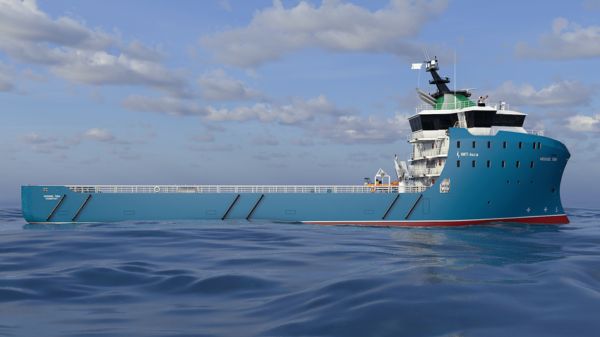
IMT Isca G-Flex vessel render. Longitude Engineering unveils IMT Isca G-Flex PSV design with alternative fuel capability  

Naval architecture firm launches adaptable platform support vessel design based on the IMT-984 G-Class hull.

Philippos Ioulianou, EmissionLink. Shore power infrastructure is key to cutting ferry emissions in European cities, says EmissionLink  

Port electrification is needed to enable vessels to switch off engines at berth, reducing urban pollution.

Maritime and Port Authority of Singapore logo. Singapore prioritises maritime resilience amid geopolitical uncertainty, eyes digitalisation and green fuels  

MPA chief outlines the sector’s adaptation to supply chain disruptions while advancing automation and alternative fuels.

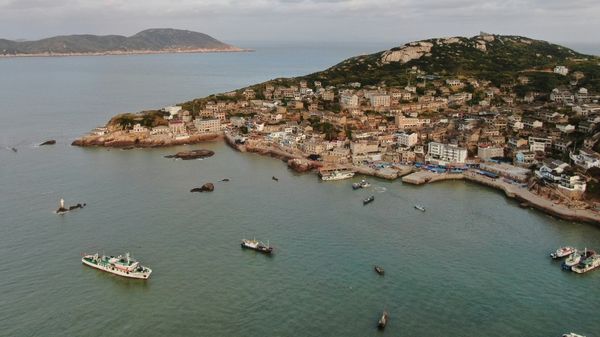
Aerial photograph of Zhoushan Island. China exports first domestically blended biofuel for marine use from Zhoushan  

A vessel carries 2,600 tonnes of biofuel blend to Qingdao Port for international ship refuelling.

Green ammonia energy workshop graphic. H2SITE to present ammonia-cracking technology at Green Ammonia Energy Workshop  

Spanish company to showcase APOLO project's role in producing hydrogen for maritime decarbonisation.

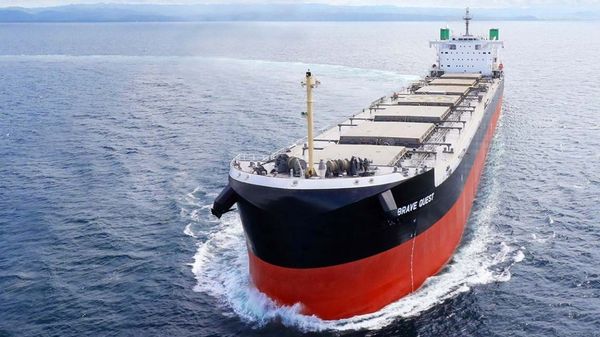
Brave Quest vessel. Tsuneishi-Cebu delivers methanol dual-fuel Kamsarmax bulker  

Philippine shipyard hands over 81,100-tonne deadweight vessel capable of running on methanol fuel.

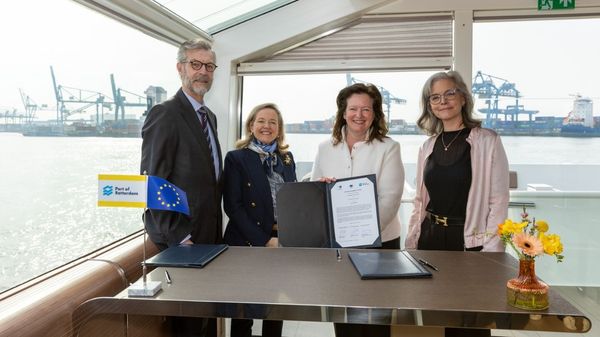
EIB and Port of Rotterdam signing. Port of Rotterdam secures EUR90m EIB loan for shore power installations  

Financing will support shore power infrastructure at three container terminals, with an EU grant also approved.

IBIA logo. IBIA updates biofuels training module for 2026  

Updated online course covers latest regulatory developments and market trends in liquid and gaseous biofuels.

Brim Explorer’s fully electric passenger vessel concept render Bureau Veritas to class all-electric trimarans for Brim Explorer  

Two zero-emission passenger vessels will operate in Norwegian fjords after extensive Arctic testing.