Thu 21 Aug 2014, 15:39 GMT

Salalah fuel storage project update


Update on the progress of the $75 million fuel bunkering project in Oman.


The chief executive officer (CEO) of Mina Group, the organization responsible for the construction of a new fuel storage facility at the port of Salalah, Oman, has provided an update on the progress of the fuel bunkering project that is designed to position Salalah as a global liquid products hub.

The Dubai-based group is investing around $75 million in the construction of the 230,000 cubic metre (cbm) storage depot in line with a contract secured from the US government to supply fuel to its vessels calling at Salalah.

Speaking to the Oman Daily Observer, Graham O'Donoghue, Group President & CEO, Mina Group, said: "Mina Petroleum is currently constructing its new facility in the Port of Salalah. All of the required regulatory permits and licenses, including environmental reviews, have been obtained. We have performed significant excavations on the land, which was rocky and initially unsuitable for tank foundations, and we have completed foundations for all nine tanks. Our fabricated steel is arriving this month for erection. Our client, the United States Defence Logistics Agency, has recently visited the site with a high-level delegation to see our progress. Mina and the Port of Salalah are collaborating closely to deliver the project within the required time frame."

Commenting on the location of the facility, O'Donoghue is quoted as saying: "The key considerations were Salalah’s strategic location and Oman’s growing economy. The location is perfect for a fuel supply point that does not require vessels to enter the Arabian Gulf via the Strait of Hormuz. Salalah has great potential, especially in light of the port's '2020 Vision', which is an ambitious expansion plan that will take advantage of its strategic position in the region."

In terms of the Salalah project's contribution to the local economy, O’Donoghue remarked: "Our project is a large capital investment in a facility that will have a thirty to forty year life span in Salalah. Financed by Bank Muscat, our project will also contribute to the financial sector of Oman’s economy. The project also involves many Omani subcontractors and service providers, including legal services, hospitality, transport, housing, telecom and financial services."

O'Donoghue also confirmed that Mina Group plans to add a second fuel depot within the port, saying: "Salalah is ideally located and the economy of Oman is growing, so Mina intends to invest in a second facility here at the Port. At this facility, which will be adjacent to the one currently under construction, Mina will build a number of storage tanks for a variety of refined products and possibly crude as well.

"Most importantly, of course, the depot will provide jobs in the Dhofar Governorate. In addition, Mina is exploring a number of options for corporate social responsibility, including sewage treatment and water purification infrastructure in rural Dhofar communities, technical training programmes for local students in fuel facilities operations and maintenance, investment in local education and recreation activities."

US Navy's refuelling plans in Oman

Earlier this year, U.S. Ambassador Greta C. Holtz and a delegation from the U.S. Embassy in Muscat travelled to the Salalah construction site. As a highlight of the trip, Ambassador Holtz was featured as the guest of honor at an Omani-American business networking reception hosted by the Port of Salalah and Mina Group. During the event, Commodore Glen Leverette, Logistic Forces Commander at the U.S. Naval Forces Central Command, spoke about the U.S. Navy's plans to expand its commercial refuelling, supply, and logistics operations in Oman's ports.


Sing Fuels logo. Sing Fuels seeks Asia-based supply trader to bolster bunker procurement team  

Singapore bunkering firm is recruiting a supply trader to manage marine fuel purchasing across Asia.

MOL joint naming ceremony. MOL names world's first ammonia-fuelled Capesize bulk carriers  

Naming of Ruri Mirai, Ruri Sekai and Ruri Hikari signals ammonia's arrival as a marine fuel for large bulk carriers.

Washington State Hybrid-Electric 160-Auto Ferry vessel render. ABB wins Washington State Ferries' third hybrid-electric vessel order  

ABB extends its role in the US ferry operator's electrification programme, which targets emission-free operations by 2050.

Aurora Borealis vessel. Kawasaki Heavy Industries delivers LPG-fuelled carrier Aurora Borealis  

Ship could also be modified in future to allow for ammonia-fuelled operation.

Rendering of Estonia's first shore-charged electric ferry. Estonian State Fleet's shore-charged electric ferry completes model testing in Germany  

Hull and propulsion tests show the vessel's energy consumption remains within contracted limits with room to spare.

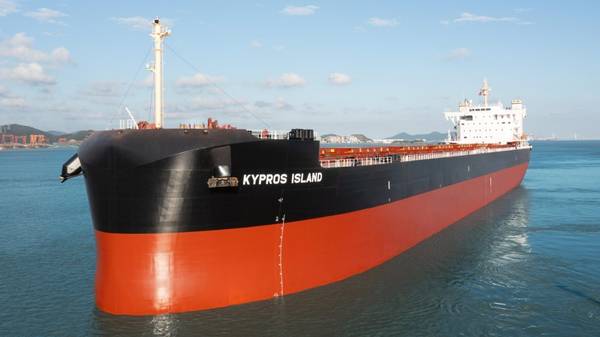
Kypros Island vessel. Tsuneishi delivers first methanol dual-fuel Kamsarmax bulk carrier from Chinese yard  

Shipbuilder claims progress towards establishing a mass-production system for vessels designed to reduce environmental impact.

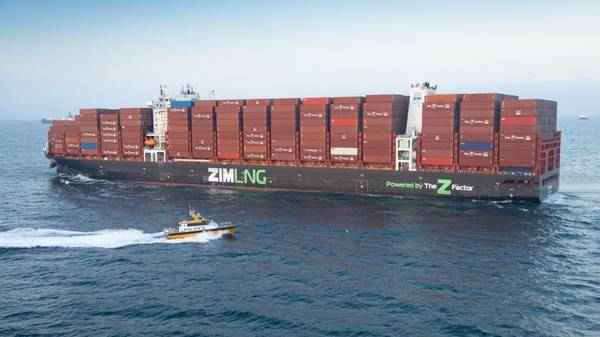
ZIM LNG container vessel. Los Angeles and Long Beach identify LNG and methanol as key near-term marine fuels  

Joint feasibility study maps out demand projections and infrastructure needs to support cleaner shipping fuels at San Pedro Bay

Alexander Treff, Christiania Energy, Christiania Energy welcomes student assistant to Copenhagen office  

Alexander Treff joins marine fuels firm while studying international business at Copenhagen Business School.

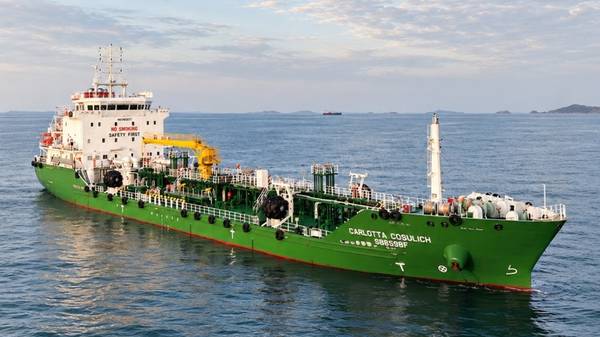
Carlotta Cosulich vessel. Cosulich Marine Energy takes delivery of third methanol-ready bunker tanker  

Carlotta Cosulich joins the group’s fleet, bringing its four-vessel bunkering programme closer to completion.

Rendering of a Wallenius Wilhelmsen vessel Wallenius Wilhelmsen orders four dual-fuel PCTCs, extends fleet renewal programme  

Shipping firm signs for LNG-fuelled car carriers with options for eight more, with deliveries from 2030.