The
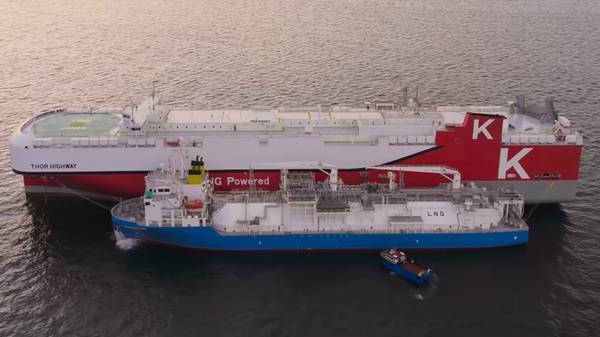
Russian Maritime Register of Shipping (RS) has completed Approval in Principal of technical documentation for the LNG tanker that is expected to form the basis of the LNG carrier fleet that will meet the future transportation requirements of
Gazprom Group.
The approved type of the ship (project name: 'Gaz-Ice') is said to exceed, in some respects, the characteristics of four state-of-the-art
Velikiy Novgorod-series LNG carriers currently under construction in South Korea for
Gazprom Marketing and Trading (GM&T) and
Shell under the supervision of
RS and
Lloyd’s Register.
As required by GM&T, two alternative designs were developed and approved, with a dual fuel diesel-electric engine (DFDE) and with two-stroke low-speed engines equipped with a sophisticated gas injection system (ME-GI) which, according to calculations, leads to a more than twofold reduction in fuel consumption as compared with 'conventional' steam power plants.
Membrane type cargo tanks of 'Gaz-Ice' with capacity of about 170,000 cubic metres (cbm) will enable the transportation of different LNG cargo sizes and a significant boil-off rate reduction owing to the use of new technologies that increase the strength and thermal insulating properties of the membrane.
"The design that has been approved by RS was developed by Korean shipbuilders together with the world's leading shipowners and LNG carrier operators. It reflects the latest advances in gas carrier design and construction. In particular, it boasts a main propulsion plant and cargo system of outstanding efficiency. The design meets the highest environmental requirements (ECO-S notation), provides for a set of measures and equipment for operation at low temperature (Winterization (-30) notation) and Arc4 ice class, which allows to use the ship for transportation of liquefied gas along the Northern Sea Route," remarked
Pavel Shikhov, RS Chief Operating Officer and Head of Classification and Development Directorate.
Nikolai Grigoriev, Director of Global Shipping and Logistics of Gazprom Marketing & Trading, said: "The demand of Gazprom Group and other Russian companies for a cost-effective and environmentally friendly tanker fleet for trading and export operations require a comprehensive approach based on a combination of innovation, best achievements of the international shipbuilding science and, practice and an increase in 'Russian content' in the construction of these ships. GM&T’s successful experience in the commercial operation of LNG carriers, the current construction of 'Velikiy Novgorod' and
'Pskov' gas carriers with our strategic partners
OAO Sovcomflot and RS, as well as the development of 'Gaz-Ice', allowed us both to define the basis for the future gas-carrying fleet of the Group and to initiate the process of preparing for the construction of these ships in Russia by 2018."