This is a legacy page. Please click here to view the latest version.
Wed 26 Jun 2019, 15:29 GMT

Coralius performs first ship-to-ship LNG bunker delivery in Rotterdam


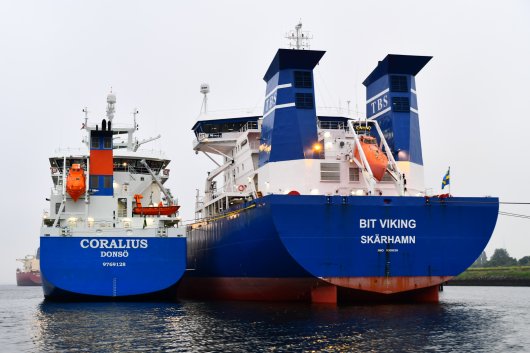
Chemical tanker Bit Viking supplied with LNG at ARA port.


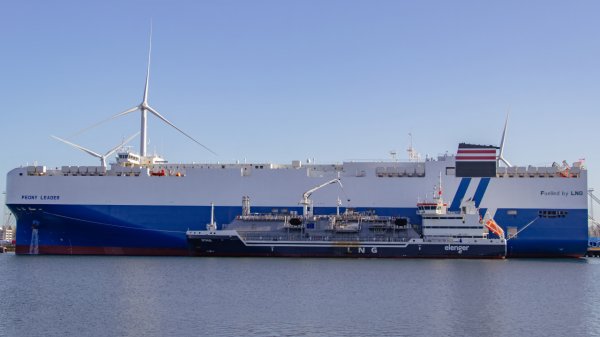
The Coralius supplies the Bit Viking during its first LNG bunkering operation in Rotterdam.
Image credit: Gasum
Gasum's LNG bunker vessel, Coralius, has performed its first ship-to-ship LNG bunker delivery in Rotterdam - supplying gas fuel to the chemical tanker Bit Viking.

The Nordic energy firm described the operation as a "bunkering milestone", with LNG now being made available to customers in the ARA (Amsterdam-Rotterdam-Antwerp) region.

Kimmo Rahkamo, Vice President, natural gas and LNG, remarked: "Finally, being able to bunker our clients in the ARA area increases LNG availability and security for the LNG[-]fueled fleet. The amount of LNG[-]driven vessels is growing rapidly globally, and we will definitely be part of the growth in being present where LNG is needed."

The Coralius carried out its maiden LNG bunker delivery back in September 2017 when the Furetank Rederi-owned Fure West was supplied in northern Kattegat, in the middle of the sea between Frederikshavn, Denmark, and Gothenburg, Sweden.

Since then, the vessel has been mainly operating in the North Sea and the Skagerrak area, and in February managed to complete its 100th bunkering operation in 18 months.

The 5,800-cubic-metre-capacity Coralius is equipped with state-of-the-art LNG transfer equipment on board and the flat working deck is said to have been especially engineered for safe side-by-side operations. Special winches have also been installed to enable safe and swift mooring operations.

The Bit Viking, meanwhile, is owned by Swedish operator Tarbit Shipping. The vessel was converted for LNG fuel operation in 2011 and was also the first to be fitted with Wärtsilä's LNGPac fuel gas handling system.

Commenting on the Coralius's Rotterdam bunker delivery, Anders Hermansson, Technical Manager of Tarbit Shipping, said: "We are happy with this opportunity to get LNG by ship-to-ship bunkering also in the Port of Rotterdam. Our vessel Bit Viking converted to LNG already in 2011. Since then, we have operated on LNG about 97 percent of the time, mainly supported by Gasum. We would like to continue on this path and consequently we are depending on reliable and flexible LNG supplies."

Gasum explained that the Coralius's ability to perform ship-to-ship bunker deliveries at sea and in port has enabled the firm to increase its flexibility and responsiveness to ships that need LNG but are unable to visit a terminal or a port.

Additionally, by making LNG more accessible to vessels, Gasum stresses that ship-to-ship bunkering also boosts efficiency.

Finland-headquartered Gasum says it foresees an increase in the average amount of LNG delivered per stem, as it will be supplying to shuttle tankers and other larger vessels.

Furthermore, Gasum notes that the Coralius has increased its efficiency due to LNG bunkering operations becoming faster.

"They are now nearly as quick as conventional oil bunkerings, which has also increased customer satisfaction," the supplier explained.


Christiania Energy headquarters. Christiania Energy relocates headquarters within Odense Harbour  

Bunker firm moves to larger waterfront office to accommodate growing team and collaboration needs.

AiP award ceremony for 20K LNGBV design. HD Hyundai Heavy Industries receives design approval for 20,000-cbm LNG bunkering vessel  

Bureau Veritas grants approval in principle following joint development project with South Korean shipbuilder.

Lloyd’s Register technical committee meeting in Spain. Peninsula outlines dual role in FuelEU Maritime compliance at Lloyd’s Register panel  

Marine fuel supplier discusses challenges for shipowners and opportunities for suppliers under new regulation.

Current status of fleet fuel types chart. LNG-fuelled container ships dominate January alternative-fuel vessel orders  

Container ships accounted for 16 of 20 alternative-fuelled vessels ordered in January, DNV reports.

Rick Boom, CIMAC and Professor Lynn Loo, GCMD. GCMD and CIMAC sign partnership to advance alternative marine fuel readiness  

Two-year agreement aims to bridge operational experience with technical standards for decarbonisation solutions.

Renewable and low-carbon methanol project pipeline chart as of January 2026. Renewable methanol project pipeline reaches 58.2m tonnes by 2031, GENA reports  

Project Navigator Methanol tracks 275 projects, including e-methanol, biomethanol and low-carbon methanol facilities globally.

Petrobras logo. Petrobras adjusts bunker pricing and minimum order volumes at Santos  

Brazilian supplier discontinues volume discount tier and lowers minimum order quantity from 1 March.

Viking Grace vessel. Viking Line secures biogas supply for 2026 after tenfold increase in biofuel use  

Åland-based ferry operator aims to maintain 50% biogas blend throughout the year on two vessels.

GNV Aurora vessel. GNV takes delivery of second LNG-powered vessel Aurora from Chinese shipyard  

Vessel to enter service on Genoa–Palermo route in April, completing first fleet renewal phase.

Tangier Maersk vessel. Maersk takes delivery of first methanol-capable vessel in 9,000-teu series  

Tangier Maersk is the first of six mid-size container ships with methanol-capable dual-fuel engines.


↑  Back to Top