This is a legacy page. Please click here to view the latest version.
Thu 12 Apr 2018, 00:03 GMT

UK government teams up with Marshall Islands to heap pressure on IMO states over GHGs


Two nations call on IMO members to reduce GHGs in the spirit of the Paris Agreement.


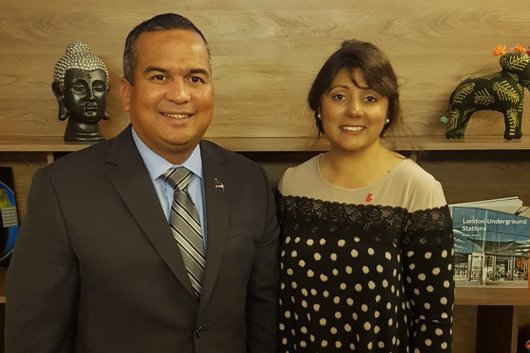
UK shipping minister Nusrat Ghani (right) meets with David Paul (left), environment minister from the Marshall Islands, on April 11, 2018.
Image credit: UK Department for Transport
The UK government has teamed up with leading shipping nation the Marshall Islands to push International Maritime Organization (IMO) members to reach a deal as quickly as possible to reduce the industry's emissions.

Shipping minister Nusrat Ghani met the Republic of the Marshall Islands' environment minister David Paul on Wednesday ahead of the conclusion of IMO talks to set a strategy to reduce greenhouse gases (GHGs) later this week.

Both countries are calling for the IMO to play its full part in global efforts to reduce GHGs in the spirit of the Paris Agreement on climate change.

Ghani said: "No other sector unites the world like maritime. We all rely on ships to transport our food, fuel and goods across the globe to our homes.

"This week is a crucial opportunity to secure the future sustainability of shipping by agreeing to cut greenhouse gas emissions as quickly as possible.

"We know that when the maritime sector comes together to address environmental matters we can achieve a great deal. Along with the Marshall Islands, we want all IMO members to come together in the final days and demonstrate that shipping will not be left behind in helping protect the planet."

David Paul, the Minister-in-Assistance to the President and Environment Minister of the Republic of the Marshall Islands, earlier this week told the Opening Plenary at the 72nd session of the Marine Environment Protection Committee (MEPC) that "the moment of truth has come for the IMO" in terms of regulating GHGs.

And on Wednesday, he remarked: "During our long seafaring histories, our two countries have seen many positive transformations in the maritime sector. The transition to net zero emissions is a massive economic opportunity waiting to be seized, and as the OECD has told us, the technology already exists to support this.

"While we the Marshall Islands have been encouraged by progress this week, we are still a long way from a deal that is consistent with the Paris Agreement. This is unacceptable. The industry has asked for certainty and we need to provide it.

"We will continue to work together with the High Ambition Coalition and our partners in the crucial days ahead to secure the strongest possible outcome. We have a chance to do the climate deal of the year."

IMO talks are expected to conclude on Friday.

The UK's Department for Transport has also published a call for evidence for Maritime 2050 - a strategy to help deliver a green revolution for the country's shipping and position the UK as a world leader in green maritime technology.

Wärtsilä logo. Shipping firms struggle to prioritise decarbonisation investments amid regulatory uncertainty, Wärtsilä survey finds  

Survey of 225 maritime executives reveals 70% say uncertainty hinders investment decisions despite regulatory pressure.

IMT Isca G-Flex vessel render. Longitude Engineering unveils IMT Isca G-Flex PSV design with alternative fuel capability  

Naval architecture firm launches adaptable platform support vessel design based on the IMT-984 G-Class hull.

Philippos Ioulianou, EmissionLink. Shore power infrastructure is key to cutting ferry emissions in European cities, says EmissionLink  

Port electrification is needed to enable vessels to switch off engines at berth, reducing urban pollution.

Maritime and Port Authority of Singapore logo. Singapore prioritises maritime resilience amid geopolitical uncertainty, eyes digitalisation and green fuels  

MPA chief outlines the sector’s adaptation to supply chain disruptions while advancing automation and alternative fuels.

Aerial photograph of Zhoushan Island. China exports first domestically blended biofuel for marine use from Zhoushan  

A vessel carries 2,600 tonnes of biofuel blend to Qingdao Port for international ship refuelling.

Green ammonia energy workshop graphic. H2SITE to present ammonia-cracking technology at Green Ammonia Energy Workshop  

Spanish company to showcase APOLO project's role in producing hydrogen for maritime decarbonisation.

Brave Quest vessel. Tsuneishi-Cebu delivers methanol dual-fuel Kamsarmax bulker  

Philippine shipyard hands over 81,100-tonne deadweight vessel capable of running on methanol fuel.

EIB and Port of Rotterdam signing. Port of Rotterdam secures EUR90m EIB loan for shore power installations  

Financing will support shore power infrastructure at three container terminals, with an EU grant also approved.

IBIA logo. IBIA updates biofuels training module for 2026  

Updated online course covers latest regulatory developments and market trends in liquid and gaseous biofuels.

Brim Explorer’s fully electric passenger vessel concept render Bureau Veritas to class all-electric trimarans for Brim Explorer  

Two zero-emission passenger vessels will operate in Norwegian fjords after extensive Arctic testing.


↑  Back to Top