Rolls-Royce has signed a teaming agreement with Italian company
Lauro Shipping to design innovative new gas-powered ferries based on the award-winning
Environship concept.
The agreement marks the first time that a customer will utilize the Environship concept for a passenger vessel.
Lauro Shipping is one of the largest ferry operators in Italy’s Campania region, providing connections to the islands of
Capri and
Ischia and specialising in high speed ferries. The company has also recently acquired
Siremar, which operates services to Sicily.
The agreement covers the basic design of a new ship class, which will be scalable for smaller and larger versions. Rolls-Royce and Lauro Shipping will jointly develop the design, prior to engaging with suitable ship yards.
Salvatore Lauro, Chief Executive of Lauro Shipping, said: "We're pleased to announce this teaming agreement with Rolls-Royce to jointly develop an innovative, environmentally friendly Ro-Pax ferry design that will meet the latest technological requirements for emissions while reducing fuel consumption and operational costs."
Neil Gilliver, Rolls-Royce, President – Merchant said: "This latest development for our Environship concept is proof that there’s a genuine desire from ship owners to embrace cutting edge marine technology to reduce environmental impact. We look forward to working with Lauro Shipping on this exciting project, which could be the first gas powered ferry operating in the Mediterranean.
"We have a huge amount of operational experience with gas powered vessels, particularly in Norway, and the fact that Lauro Shipping is leading the way in the Mediterranean, further enhances the global prospects for liquid natural gas (LNG) as a marine fuel."
The NVC 256 will carry passengers and vehicles and is the latest ship design from the Rolls-Royce Environship range, incorporating a variety of features to reduce environmental impact while increasing efficiency, including an engine powered by LNG.
The new ferry concept will incorporate a Rolls-Royce solution including systems, equipment and ship design. This includes Bergen engines, a wave piercing bow and a Promas propulsion system which combines a propeller and rudder, reducing drag and enhancing manoeuvrability.
Another feature of the propulsion system is the Rolls-Royce Hybrid Shaft Generator (HSG), which produces electrical power from the propulsion engines instead of running auxiliary diesel generators. This optimizes on board power generation, cutting fuel consumption and exhaust emissions.
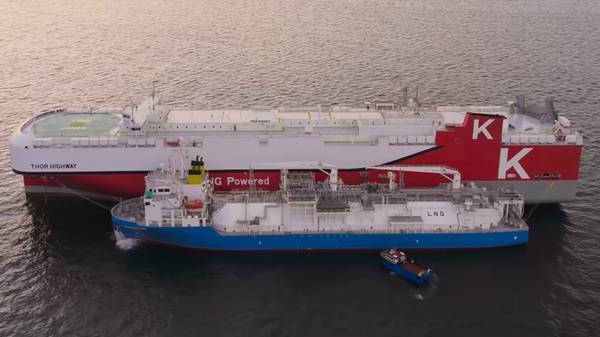
The Lauro Shipping deal is the latest in a series of recent achievements for Rolls-Royce LNG powered ships, which includes the world’s first gas powered tugs, coastal cargo ships and passenger ferries. The world’s first LNG powered cargo ship, powered by Rolls-Royce, entered service in Norway earlier this year.
Key facts about the Environship:
* The Rolls-Royce Environship concept, received the prestigious Next Generation Ship Award at the 2011 NorShipping event in Oslo, Norway.
* The Rolls-Royce Bergen B&C Series lean burn gas engines, as used in the Environship, emit around 22 percent less CO2 (per unit of power) than a diesel engine.
* The use of gas-fuelled engines means that Nitrogen Oxide (NOx) emissions are reduced by about 90 percent while Sulphur Oxide (SOx) emissions are negligible.
* These emissions are already within the limits of IMO (International Maritime Organisation) Tier III environmental legislation, due to come into force in 2016.
* The Rolls-Royce Promas propulsion system is an integrated rudder and propeller, which alone improves efficiency of the vessel by 5 to 8 percent.
* The new innovative bow shape and hull form, designed by Rolls-Royce, also reduce resistance by up to 8 percent, therefore reducing fuel burn and emissions further.
* The vertical bow shape enables the vessel to maintain speed even in rough seas, enabling operators to achieve demanding shipping schedules without the need to burn additional fuel to make up lost time.
* Rolls-Royce Hybrid Shaft Generator (HSG) optimises on board power generation, cutting fuel consumption and exhaust emissions.