Marine scrubbing technology manufacturer
Hamworthy Krystallon has announced that the first of four vessels installed with the company's seawater scrubbers for leading Italian ship owner
Ignazio Messina & Co has come on line.
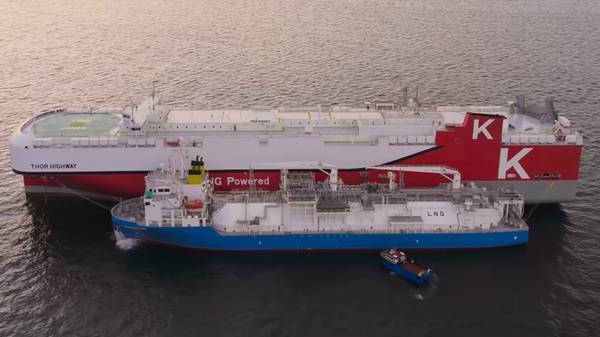
Linea Messina [pictured] is said to be the first ever vessel to operate commercially with a scrubber system, enabling Ignazio Messina to meet 0.1% sulphur emissions regulations in EU ports, as well as 'future-proofing' the vessel for the impending 2015 0.1% Emission Control Area (ECA).
"This is a landmark moment, not just for Hamworthy Krystallon, but the entire shipping industry," said
Sigurd Jenssen, Managing Director, Hamworthy Krystallon. "Bringing Linea Messina on line highlights the validity of scrubbing technology as a viable and cost-effective solution to meet the stringent sulphur emissions regulations, that are serving to transform the shipping industry."
"By 2015, ship owners and operators operating in ECAs will have a simple choice - either pay the $300 to $400 price differential for costly distillate fuel or install a scrubber, which typically has a payback of less than 2 years. Messina has shown what the smart choice is," continued Jenssen.
Ignazio Messina placed the world's first commercial order for seawater scrubbers in 2010, to be installed on four new 45,000 dwt Ro-Ro vessels. Each ship features five scrubbers, consisting of four units for the auxiliary engines (each 2MW) and one unit for the auxiliary boiler (2.5 tons steam per hour). All the scrubbers will be housed within the ship funnel casings. Equipment will also include a control system, combined wash-water treatment plant and a new range of super duplex stainless steel pumps supplied by Hamworthy's Singapore plant. All emissions will be continuously monitored.
The delivery of the equipment for Linea Messina took place in January 2011, followed by installation throughout the summer. DNV approved the installation during testing in October 2011, and it has also achieved RINA classification; all vessels are the first of their type to gain RINA's Green Plus notation. Additionally the system is MED certified. Linea Messina will operate along the African coast as well as in Italian waters.
Enrico Allieri, Ignazio Messina's New Buildings program Technical Director, commented: "Installing Hamworthy Krystallon's scrubber system was the right commercial and environmental decision. The shipping industry is changing dramatically and it will continue to do so, particularly in relation to the environment, and we wanted to be ready for these new challenges."
"We can now comply with the 0.1% sulphur regulation in EU ports, while burning residual fuel oil and we are now prepared for the 2015 regulation, which will have a significant impact on the industry. What has been clear is that preparation is key as the solutions take time to install and test. But we are now ready and have a competitive advantage in looking to seize the opportunities that change will inevitably bring. The first vessel,
Jolly Diamante was delivered on 9th December and is now on its maiden voyage to the Mediterranean Sea. We will continue to participate in Hamworthy Krystallon's R&D program which will closely monitor the scrubbers during operations, as a means of continuously improving the characteristics of the scrubbing systems," concluded Allieri."