Thu 15 Aug 2019, 10:28 GMT

Maersk posts higher average bunker price, lower consumption


As a result, fuel costs rose marginally (0.4%) in Q2 and declined by 2% in H1.


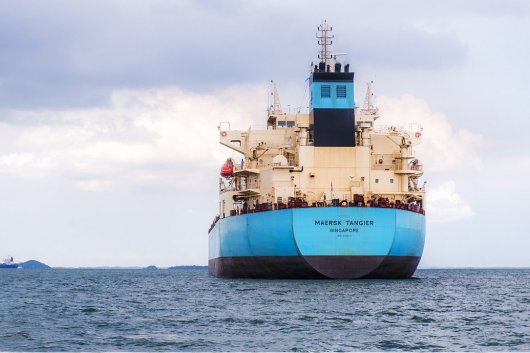
Image credit: Maersk
A.P Moller - Maersk reports that the average bunker price rose year-on-year (YoY) by $35, or 8.7 percent, to $436 per tonne during the second quarter (Q2) of 2019.

For the first six months (H1), the mean bunker price was $426 per tonne, which was $35 - or 9.0 percent - higher than the $391-per-tonne figure recorded in the prior-year period.

Maersk: Average bunker price

2019 ($/mt) 2018 ($/mt)
Q2 436 401
H1 426 391
Source: Maersk


However, whilst bunker prices were higher, the total amount of marine fuel consumed by Maersk in Q2 fell by 225,000 tonnes, or 7.5 percent, to 2.777m tonnes; and in H1, bunker use declined by 615,000 tonnes, or 10.0 percent, to 5.516m tonnes.

Maersk: Bunker consumption

2019 (MMT) 2018 (MMT)
Q2 2.777 3.002
H1 5.516 6.131
Source: Maersk


As a result, the overall spend on marine fuels was up marginally by $5m, or 0.4 percent, to $1.210bn. In H1, meanwhile, bunker costs decreased by $47m, or 2.0 percent, to $2.352bn.

Maersk: Bunker costs

2019 ($bn) 2018 ($bn)
Q2 1.210 1.205
H1 2.352 2.399
Source: Maersk


Ocean EBITDA and revenue

The Ocean division achieved an increase in Q2 revenue of $198m, or 2.8 percent, to $7.15bn. In H1, sales climbed $317m, or 2.3 percent, to $14.079bn.

EBITA, meanwhile, rose YoY by $212m, or 24.8 percent, to $1.068bn in Q2, and by $487m, or 32.3 percent, to $1.995bn in H1.

Maersk's Ocean segment includes the ocean activities of Maersk's Liner Business (Maersk Line, MCC, Seago Line and Sealand) together with Hamburg Sud brands Hamburg Sud and Alianca as well as strategic transshipment hubs under the APM Terminals brand.

A.P. Moller - Maersk: key results

Maersk posted a Q2 underlying profit of $134m - up $119m on the previous year's figure. In H1, the Danish firm achieved a profit of $65m, compared to the $314m loss posted in H1 2018.

EBITDA in Q2 increased YoY by $195m, or 16.8 percent, to $1.357bn; and half-year EBITDA climbed $500m, or 23.9 percent, to $2.593bn.

Revenue in Q2 rose YoY by $59m, or 0.6 percent, to $9.627bn, whilst in H1 it grew $294m, or 1.6 percent, to $19.167bn.

Guidance

In its guidance for 2019, Maersk said that a $100 change in the price of bunker fuel (net of expected BAF coverage) would lead to the group's EBITDA varying by $200m.

Maersk maintains that it still expects to post an EBITDA of around $5.0bn in 2019.


Container ship near a port. Ammonia emerges as most feasible alternative fuel for deep-sea shipping in 2050 emissions study  

Research combining expert survey and technical analysis ranks ammonia ahead of hydrogen and methanol.

Cargo vessel at sea. EMSA study examines biodiesel blend spill response as shipping adopts alternative fuels  

Research addresses knowledge gaps on biodiesel-conventional fuel blends as marine pollutants and response measures.

BIMCO ETS BARECON clause 2026 graphic. BIMCO adopts ETS clause for bareboat charters, delays biofuel provision  

BIMCO’s Documentary Committee has approved an emissions trading compliance clause while requesting further work on a biofuel charter provision.

SALEFORM 2025 standard form graphic. BIMCO and Norwegian Shipbrokers’ Association launch SALEFORM 2025 ship sale contract  

Updated agreement addresses banking changes, compliance requirements and environmental regulations affecting vessel transactions.

Everllence H2 test engine. Everllence develops hydrogen test bench for marine engines  

German engine maker upgrades Augsburg facility under HydroPoLEn project backed by federal maritime research funding.

CMA CGM Osmium vessel. CMA CGM names 13,000-teu methanol-fuelled containership in South Korea  

CMA CGM Osmium to operate on Asia–Mexico service as part of the carrier’s decarbonisation strategy.

NorthStandard logo. NorthStandard publishes biofuel guide as marine insurance claims emerge  

White paper addresses quality issues and compliance requirements as biofuel testing volumes surge twelvefold.

Clean Maritime Fuels Platform (CMFP) logo. Maritime fuel platform calls for EU shipping ETS revenues to fund clean fuel deployment  

Clean Maritime Fuels Platform urges earmarking of national emissions trading revenues for renewable fuel infrastructure.

Seatransport 73m SLV Lloyd’s Register grants approval for hybrid nuclear power design for amphibious vessels  

Classification society approves Seatransport’s concept integrating micro modular reactors with diesel-electric systems.

Everllence ME-LGIE engine. Everllence and Vale partner on ethanol-powered marine engine development  

Brazilian mining company to develop dual-fuel ethanol engines based on ME-LGI platform.