Thu 3 May 2018, 08:47 GMT

BIMCO's Documentary Committee approves revised bunker contract


BIMCO expects inclusion of liability cap - along with other changes - will lead to a wider adoption of the contract.


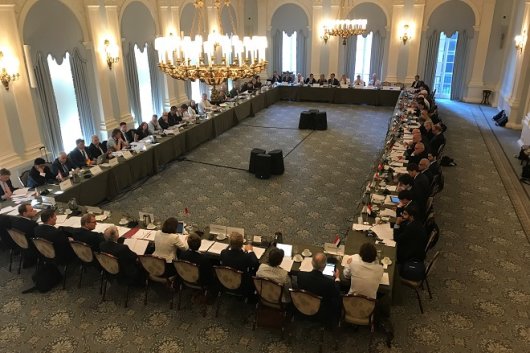
BIMCO's Documentary Committee held its meeting on May 2, in New York, hosted by the Maritime Law Association of the United States.
Image credit: BIMCO
As anticipated, BIMCO's Documentary Committee approved a new set of standard bunker terms in New York on May 2.

The BIMCO Bunker Terms 2018 have been drafted in an effort to improve on the previous edition, and now include a maximum limit of the parties' liabilities - a key change that BIMCO expects will lead to a wider adoption of the contract.

"I think it is a positive step for the industry that representatives for the bunker traders and shipowners have agreed on a standard set of terms, which both parties consider fair and balanced," said Francis Sarre, Chair of the BIMCO Documentary Committee.

The trader representatives who helped draft the contract together are said to account for 25 percent of the total bunker volume sold globally, which BIMCO sees as "a very strong sign of support for the final result".

The BIMCO Bunker Terms 2018 also have the support of the International Bunker Industry Association (IBIA), BIMCO noted.

Francis Sarre hopes the changes to the terms and the broad support will lead to a wide adoption of the standard terms across the industry and help improve and speed up bunker transactions and reduce disputes.

"We all need to improve efficiency and cut costs. With a widely used standard contract all parties involved should save time on drafting contracts and get greater clarity on the contractual obligations and liabilities in the contract. This will hopefully bring more transparency to the bunker industry," Sarre remarked.

Cap on liabilities

The BIMCO Bunker Terms 2018 include a default limit of the invoice value, or USD 500,000, whichever is higher. The USD 500,000 is a default minimum figure that the parties can increase, if appropriate.

Other key changes

The new form also contains detailed delivery provisions for when the bunkers must be delivered, both in situations when the vessel is ready to receive fuel within the agreed delivery window and when it is not.

In terms of payment, the default credit period is 30 days, which corresponds to general market practice. BIMCO argues that to remove the credit period altogether "would not be realistic" given the amount of financing provided to the marine fuel sector, so "buyers would not have the liquidity to cope without the credit".

The BIMCO Bunker Terms also include comprehensive provisions regarding claims management for quantity, quality and delay claims.

Documentary Committee

The BIMCO Documentary Committee consists of over 60 people from across the shipping industry, including: shipowners, ship operators, representatives from P&I clubs and national shipowner and shipbroker associations.

The committee also has several observers including the International Group of P&I Clubs, the International Chamber of Shipping, Intertanko, the Maritime Law Association of the US and FONASBA.

Wednesday's New York meeting was hosted by the Maritime Law Association of the US.


Zhoushan waterfront at night. Zhoushan becomes world's third-largest bunker port  

Chinese refuelling hub overtakes Antwerp-Bruges and Fujairah to take third place in 2025.

Meyer Turku's net-zero vessel concept render. Meyer Turku completes net-zero cruise ship concept with 90% emissions cut  

Finnish shipbuilder’s AVATAR project vessel design exceeds IMO targets using technologies expected by 2030.

Uni-Fuels Logo. Uni-Fuels renews ISCC certification after first biofuel delivery  

Singapore-based marine fuel supplier completes inaugural ISCC-certified biofuel delivery, supporting EU regulatory compliance.

Close-up of a vessel bow at port. Iberian Peninsula poised to overtake the Netherlands as Europe’s top LNG bunkering hub  

Spanish and Portuguese ports quadrupled ship-to-ship LNG supply in two years, data shows.

FOBAS Fuel Insight Fuel Quality report H2 2025 cover. Lloyd’s Register reports sharp rise in marine fuel quality failures in late 2025  

December recorded the highest monthly off-specification cases, driven by sulphur, catalytic fines and flash point issues.

Bio-LNG bunkering infrastructure. Bahía de Bizkaia Gas launches bio-LNG loading service after ISCC certification  

Spanish regasification terminal begins offering renewable fuel loading for trucks and vessels in January 2026.

Grande Michigan vessel. Grimaldi takes delivery of eighth ammonia-ready car carrier Grande Michigan  

The 9,000-ceu vessel features 50% lower fuel consumption and 5 MWh battery capacity.

Graphic of the ABS logo with a blue background and light effects over a globe. ABS consortium delivers ammonia fuel safety report for EMSA  

Report expands on IMO interim guidelines and highlights need for comprehensive understanding of ammonia properties.

Green Future vessel. NYK operates methanol-fuelled bulk carrier for BHP, claims 65% emissions cut  

Green Future becomes first oceangoing bulk carrier to use low-carbon methanol fuel.

Genesis Sea vessel. Ulstein Verft completes sea trials for Genesis Sea CSOV ahead of spring delivery  

The 89.6-metre vessel features hybrid battery propulsion and preparations for green methanol operation.