Gate terminal, a subsidiary of Dutch firms
Vopak and
Gasunie, has announced that it has signed a financing agreement with the
European Investment Bank (EIB) and four other banks that already participate in the syndicate of ten international banks which currently provide long-term financing to Gate terminal. The additional financing is to fund the expansion of the liquefied natural gas (LNG) break bulk infrastructure and services at the Gate terminal in the
Port of Rotterdam.
The investment in this break bulk infrastructure, first announced in July 2014, is expected to boost the use of LNG as a cleaner alternative transportation fuel in the Netherlands and Northwest Europe. The new infrastructure will be located next to Gate terminal.
The new financial agreement is an addition of EUR 76 million to the existing long-term debt financing program of Gate terminal of EUR 750 million, originally established in 2008.
The ceremonial signing of the financing agreement took place in Rotterdam in the presence of
Pim van Ballekom, EIB Vice President for the Netherlands;
René Oudejans, member of the executive board and chief financial officer (CFO) at Gasunie;
Jack de Kreij, vice chairman of the executive board and CFO at Royal Vopak;
Dick Meurs, managing director at Gate terminal; and
Paul Smits, CFO at the Port of Rotterdam.
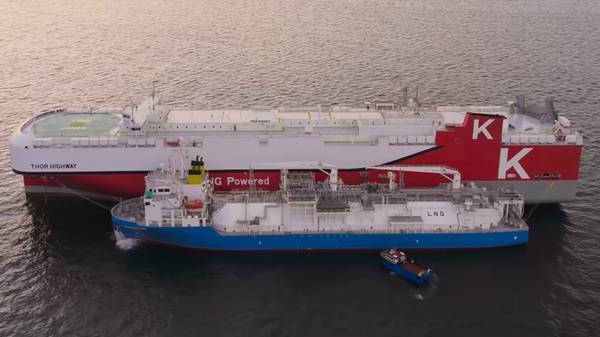
The construction of the new break bulk infrastructure is due to begin later this year. Commissioning of the facility and commencement of the first services are scheduled for the first half year of 2016. Gate terminal is to be expanded with an additional harbour basin, financed by the Port of Rotterdam, that will enable LNG distribution for small-scale use with a maximum capacity of 280 berthing slots per year. As the launching customer,
Shell is set to play a key role in enabling the project.
In January 2014, Gate terminal launched a loading station for trucks and containers, with a total capacity of 5,000 trucks per year. The new break bulk facility will continue the further development of the terminal into a hub, from where LNG can be re-exported to other parts of Europe and around the world.
René Oudejans and Jack de Kreij jointly commented: "We are proud that the European Investment Bank and a strong international group of reputable banks expanded their long term financing to Gate terminal. With this funding we can, in a disciplined way, step by step further develop Gate terminal. This new break bulk infrastructure will facilitate the usage of LNG as a low emission fuel all over Europe." Pim van Ballekom said: “Gate terminal is essential for the security of energy supply in Europe. The expanded facility will not only benefit Rotterdam, but also enhance the supply capacity of an important alternative fuel for transportation and industry in Europe. The European Investment Bank is pleased to build on previous support for both Gate Terminal and Maasvlakte and is committed to working with other banks to address Europe’s energy needs."
The expansion of the financing facility will have a maturity in line with the existing financing which expires at the end of 2029. The EIB has agreed to finance EUR 38 million and the syndicate of four banks a maximum of EUR 38 million supported by an additional guarantee facility.
"The project is key to facilitate LNG storage and to secure LNG supply in Northwest European ports, such as Gothenburg. The maritime connection between Rotterdam and these ports is regarded as a part of the EU 'motorways of the sea' concept and has therefore been selected for cofinancing under the European Union's
TEN-T [Trans-European Transport Networks] programme," a joint statement said.