This is a legacy page. Please click here to view the latest version.
Wed 13 Sep 2017, 09:41 GMT

Singapore achieves best six-month bunker sales result in its history and record volume for August


Asian port surpasses 25 million tonnes in a six-month period for only the second time.


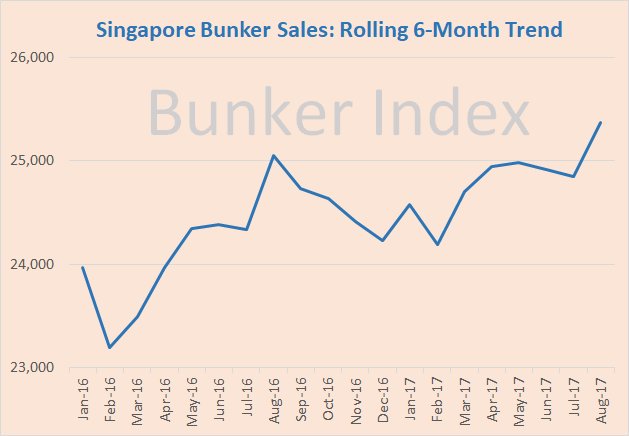
[Click for enlarged graph of Singapore Bunker Sales: Rolling Six-Month Trend - Jan 2016 - Aug 2017]

The port of Singapore recorded the best six-month bunker sales figure in its history between March and August, according to data compiled using information released by the Maritime and Port Authority of Singapore (MPA).

Sales of marine fuel at the world's leading bunker port between March and August were 25.369 million metric tonnes - beating the previous six-month record of 25.053 million tonnes, achieved between March and August last year.

In another record for the Asian port, Singapore sold 4,363,600 tonnes of marine fuel in August, which was the best ever sales figure for this month, surpassing the 4,287,800-tonne result in August 2015.

Year-on-year (YoY), August sales were up 135,600 tonnes, or 3.2 percent. In a month-on-month (MoM) comparison with July, bunker volumes delivered dipped 30,100 tonnes, or 0.7 percent.

Accumulated sales for the first eight months of 2017, meanwhile, were 33,678,000 tonnes - a YoY increase of 950,900 tonnes, or 2.9 percent.

With fuel grades 380 centistoke (cSt) and 500 cSt recording sales of 3,234,400 tonnes and 892,200 tonnes respectively, they both came close to achieving record peaks for August. The 380 cSt figure was just below the 3,295,600-tonne result seen in August 2015, while the 897,700 tonnes sold in 2016 remains the best August result for 500 cSt.

In comparison with last year, 380 cSt sales were up 117,800 tonnes, or 3.8 percent; MoM, 380 volumes fell 71,900 tonnes, or 2.2 percent.

Low-sulphur marine gas oil (LSMGO) recorded its best ever August figure and a YoY increase with sales of 109,600 tonnes - a rise of 23,600 tonnes, or 27.4 percent. Compared to the previous month, the result was up 5,300 tonnes, or 5.1 percent.

Vessel arrivals and bunker calls

According to the MPA, the number of ships greater than 75 gross tonnes (gt) calling at Singapore for bunkers in August was 3,334 - a fall of 227, or 6.4 percent, compared to last year.

So far in 2017, every month has recorded a decline in the number of bunker calls compared to last year.

In comparison with the previous month, the number of bunker calls was also down - by 52.

The total number of vessels greater than 75 gt arriving in Singapore increased YoY by 207, or 1.8 percent, to 11,915 in August. MoM, vessel arrivals were up 107, or 0.9 percent.

Image: Singapore bunker sales: rolling six-month trend.


Zhoushan waterfront at night. Zhoushan becomes world's third-largest bunker port  

Chinese refuelling hub overtakes Antwerp-Bruges and Fujairah to take third place in 2025.

Meyer Turku's net-zero vessel concept render. Meyer Turku completes net-zero cruise ship concept with 90% emissions cut  

Finnish shipbuilder’s AVATAR project vessel design exceeds IMO targets using technologies expected by 2030.

Uni-Fuels Logo. Uni-Fuels renews ISCC certification after first biofuel delivery  

Singapore-based marine fuel supplier completes inaugural ISCC-certified biofuel delivery, supporting EU regulatory compliance.

Close-up of a vessel bow at port. Iberian Peninsula poised to overtake the Netherlands as Europe’s top LNG bunkering hub  

Spanish and Portuguese ports quadrupled ship-to-ship LNG supply in two years, data shows.

FOBAS Fuel Insight Fuel Quality report H2 2025 cover. Lloyd’s Register reports sharp rise in marine fuel quality failures in late 2025  

December recorded the highest monthly off-specification cases, driven by sulphur, catalytic fines and flash point issues.

Bio-LNG bunkering infrastructure. Bahía de Bizkaia Gas launches bio-LNG loading service after ISCC certification  

Spanish regasification terminal begins offering renewable fuel loading for trucks and vessels in January 2026.

Grande Michigan vessel. Grimaldi takes delivery of eighth ammonia-ready car carrier Grande Michigan  

The 9,000-ceu vessel features 50% lower fuel consumption and 5 MWh battery capacity.

Graphic of the ABS logo with a blue background and light effects over a globe. ABS consortium delivers ammonia fuel safety report for EMSA  

Report expands on IMO interim guidelines and highlights need for comprehensive understanding of ammonia properties.

Green Future vessel. NYK operates methanol-fuelled bulk carrier for BHP, claims 65% emissions cut  

Green Future becomes first oceangoing bulk carrier to use low-carbon methanol fuel.

Genesis Sea vessel. Ulstein Verft completes sea trials for Genesis Sea CSOV ahead of spring delivery  

The 89.6-metre vessel features hybrid battery propulsion and preparations for green methanol operation.


↑  Back to Top


 Recommended