This is a legacy page. Please click here to view the latest version.
Fri 6 Sep 2013, 20:12 GMT

Agreement to build oil storage terminal in Saldanha Bay


Storage and blending terminal will have a total capacity of 13.2 million barrels.


Oiltanking Grindrod Calulo Holdings (Pty) Ltd. (OTGC), a subsidiary of Oiltanking GmbH, and Mining, Oil and Gas Services Pty Ltd. (MOGS) have announced a joint venture agreement to construct a commercial crude oil storage and blending terminal with a total capacity of 13.2 million barrels comprising twelve 1.1 million bbls concrete tanks in the Port of Saldanha Bay.

The development, construction, management and operations of the terminal will be carried out by the new company called Oiltanking MOGS Saldanha (Pty) Ltd. (OTMS). MOGS initiated the project in 2011 and has since completed the pre-feasibility studies and design and is in the final stages of obtaining the required statutory approvals. MOGS and OTGC will each hold 50 percent of shares in the company.

Port of Saldanha Bay is an excellent location for a crude oil hub as it is close to strategic tanker routes from key oil producing regions to major oil consuming markets. It is ideally situated for the blending of West African and South American crude oils. Port of Saldanha Bay has the potential to establish itself as a global crude transhipment hub focussed on certain established trade routes.

The new crude oil terminal in the Port of Saldanha Bay will be built as state-of-the-art facility in accordance with the highest technical, operational and environmental standards. The existing jetty can handle vessels up to VLCC (very large crude carrier) size.

Oiltanking Grindrod Calulo Holdings (Pty) Ltd is an independent bulk liquid storage provider in South Africa which combines the expertise of Oiltanking GmbH in the field of bulk liquids handling with the local expertise and the full Black Economic Empowerment credentials of Grindrod South Africa (Pty) Ltd. and Calulo Terminals (Pty) Ltd. Through direct holdings via Calulo and indirect holding via Grindrod South Africa, the joint venture is a fully empowered entity with a level 2 empowerment classification.

MOGS (Pty) Ltd. is a subsidiary of Royal Bafokeng Holdings (Pty) Ltd. (RBH) and is a BBBEE accredited holding company that focuses on providing a selection of products and services to the mining, oil and gas services industry in South Africa, Africa and the Middle East.

Oiltanking GmbH is a subsidiary of Marquard & Bahls AG, Germany, a leading petroleum company, privately owned. Oiltanking is the second largest independent tank storage provider for petroleum products, chemicals and gases worldwide. The company owns and operates 73 terminals in 23 countries within Europe, North and South America, Middle East, Africa, India as well as Asia. Oiltanking has an overall storage capacity of 20.4 million cubic meters.

Grindrod South Africa (Pty) Ltd is a company with more than 100 years’ experience in South Africa’s freight movement, providing shipping and logistics solutions to clients. Grindrod’s operations are focused on transportation, storage and handling of dry and liquid bulk commodities, containers and automobiles, their operations also extend to include commodity trading and financial services.

Calulo Terminals (Pty) Ltd is a South African black owned and controlled investment company focusing on oil and chemical sectors. Calulo has significant holdings in companies throughout the value chain and controlling interests in companies which focus on providing comprehensive logistics solutions to the oil, gas and chemical sectors. .


IBIA MFM bunkering training course graphic. IBIA announces new date for mass flow meter training course in Rotterdam  

Training scheduled for 12 May follows mandatory MFM implementation at Rotterdam and Antwerp-Bruges ports.

A Maersk vessel, pictured from above. Maersk and Hapag-Lloyd suspend Strait of Hormuz transits amid Middle East security crisis  

Container carriers reroute services around the Cape of Good Hope as military conflict escalates.

Map of Middle East. Operations continue as normal at most Middle East ports  

Most facilities operating normally, with exceptions in Bahrain, Oman and Saudi Arabia.

Photograph of the 93,000-cbm very large ammonia carrier (VLAC) Gaz Ronin. Naftomar takes delivery of 93,000-cbm dual-fuel ammonia carrier  

Gaz Ronin features a MAN dual-fuel engine with high-pressure selective catalytic reduction technology.

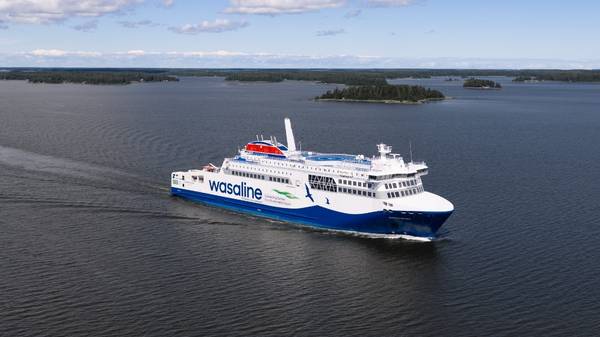
Aurora Botnia leaving harbor. AYK Energy completes world’s largest marine battery retrofit on Wasaline ferry  

Aurora Botnia receives 10.4 MWh battery system, bringing total capacity to 12.6 MWh.

Steel cutting ceremony for an LNG dual-fuel 307,000-tonne crude oil tanker with builder's hull no. 113. Dalian Shipbuilding begins construction on LNG dual-fuel crude tanker  

Development is one of a number of milestones reported by parent company over the past few days.

Photograph of Sallaum Lines' Ocean Breeze vessel with 'Introducing The Blue Corridor' overlaid text. Sallaum Lines launches Blue Corridor sustainability initiative for Europe–Africa ro-ro trade  

Company deploys LNG-capable vessels with AI routing and eco-speed protocols on new green shipping corridor.

The platform supply vessel Viking Energy. Eidesvik Offshore signs yard contract for ammonia retrofit of PSV Viking Energy  

Halsnøy Dokk to convert platform supply vessel as part of EU-backed Apollo project.

Vanquish tanker alongside Jette Theresa oil/chemical tanker docked at terminal. North Sea Port completes risk analysis for alternative fuel bunkering operations  

Port authority says LNG, hydrogen, methanol and ammonia can be safely refuelled across its facilities.

Container ship near a port. Ammonia emerges as most feasible alternative fuel for deep-sea shipping in 2050 emissions study  

Research combining expert survey and technical analysis ranks ammonia ahead of hydrogen and methanol.


↑  Back to Top


 Recommended